

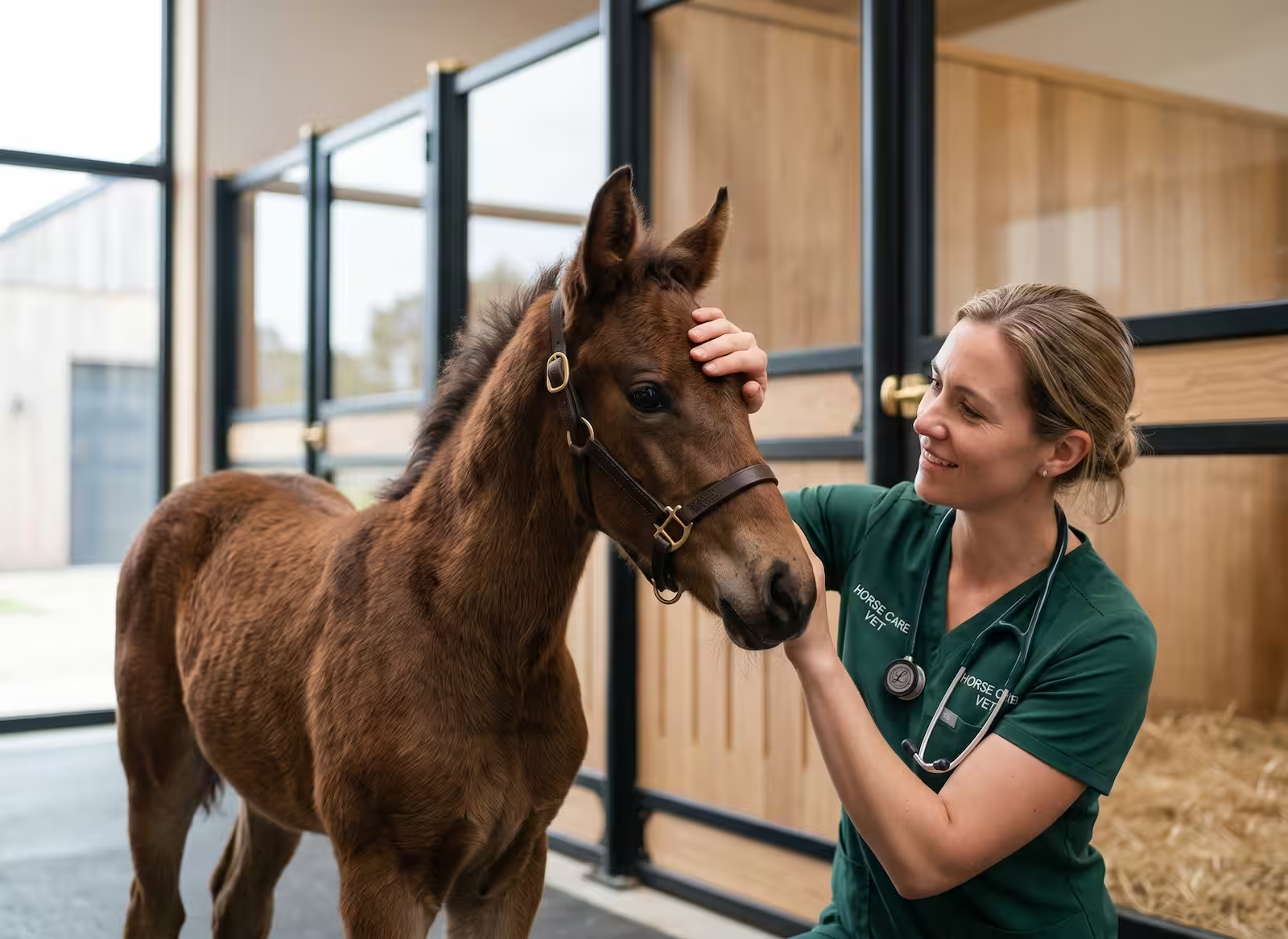
Hydrotherapy used to sit on the periphery of equine veterinary practice — a "nice to have" referenced in discharge instructions, run by a stable manager somewhere off-site, with no real protocol behind it. That has changed. Veterinary clinics that have added in-house hydrotherapy capability over the last decade — water treadmill, cold saltwater spa, or both — have re-positioned hydrotherapy as a core post-surgical and rehabilitative tool, prescribed by the veterinarian, run on a defined protocol, and integrated with the clinical record.
This article is written for veterinary surgeons, rehabilitation veterinarians, and clinic owners considering a hydrotherapy installation or refining an existing program. It covers the principal clinical indications, the protocols that are working in practice in 2026, the contraindications that matter, and the operational considerations of integrating hydrotherapy into a working equine hospital.
Three trends are pushing hydrotherapy into the hospital. Earlier mobilization protocols in post-surgical recovery — the same trend that transformed human orthopaedic recovery in the 2010s — are now standard in equine practice, and water environments allow earlier weight-bearing than dry-land alternatives. Improved imaging means clinicians are diagnosing soft-tissue and joint pathology earlier, when conservative rehabilitation is more likely to succeed, and hydrotherapy is the most controllable rehab environment available. Owner expectations have shifted — referring vets, trainers, and owners increasingly expect a hydrotherapy plan as part of a discharge package for any soft-tissue or post-operative case.
The clinic that owns the modality controls the protocol. That matters clinically, and it matters commercially.
In equine clinical practice, hydrotherapy is most commonly prescribed for four categories of case, and most clinics report that these four account for roughly 80% of hydrotherapy use.
Each indication has its own protocol. The mistake clinics make in the first year is treating "hydrotherapy" as a single prescription. It is not — it is four (or more) distinct prescriptions delivered through the same equipment.
Hydrotherapy is one of the most clinically valuable interventions in the post-arthroscopic period. The water environment allows controlled, low-concussion weight-bearing at a stage where dry-land exercise is contraindicated, accelerates resolution of joint effusion, and limits the deconditioning that historically accompanied prolonged stall rest.
Timeline. For uncomplicated arthroscopy with no major capsular work, water treadmill activity typically begins between days 10 and 14 post-op, after the surgeon confirms wound healing and stable joint capsule. For more invasive procedures or where the joint capsule was significantly involved, delay to days 21 to 28.
Starting parameters. Cannon-deep water, five minutes of in-water walk time, twice weekly for the first two weeks. The goal is mobilization, not conditioning. The hydrostatic compression reduces joint effusion measurably within two to three sessions in most clinical cases.
Progression. Build depth and duration over weeks 3 to 8 post-op. Avoid incline and trot work until full radiographic and clinical clearance — typically week 10 to 12 for fetlock or tarsal arthroscopy. Sessions move from twice-weekly to three or four times weekly through week 6.
Cold saltwater spa. In acute post-operative inflammation (days 3 to 14), the ECB Equine Spa is the more appropriate modality. The depth of the spa allows distal-limb compression without the gait requirement of the treadmill, and the cold + salt combination accelerates resolution of acute joint effusion in fetlock, pastern, and tarsal cases. Many clinics use the spa as the first-line modality for the first 14 days, then transition to the treadmill.
Suspensory ligament desmitis and superficial digital flexor tendinopathy are the highest-volume soft-tissue cases in most equine clinics. Both respond well to a structured hydrotherapy rehabilitation program, and both fail when the program is unstructured.
Diagnostic baseline. Ultrasound the lesion, confirm location and grade, and document baseline measurements. Hydrotherapy protocols must be matched to the lesion — proximal suspensory desmitis and SDFT body lesions do not rehabilitate on the same parameters.
Phase 1 (weeks 1 to 4 post-diagnosis). Cold saltwater spa daily, no treadmill. The combination of cold, hydrostatic compression, and salinity resolves the acute inflammatory phase and creates a stable baseline. Begin in-hand walking on the dry on day 14 if the veterinarian clears.
Phase 2 (weeks 5 to 12). Introduce water treadmill at cannon depth, walk-only, three sessions per week. Build to mid-radius/tibia depth by week 8. Continue spa on non-treadmill days. Ultrasound re-check at week 8.
Phase 3 (weeks 13 to 24). Progressive loading on the treadmill — depth, duration, then incline. Trot work introduced only after ultrasound confirms appropriate fiber alignment. Walk-only programs continue as the spinal-loading minimum.
Phase 4 (return to work). Treadmill becomes a maintenance and conditioning tool. The horse is transitioning back to ridden or track work. Continue spa as a preventive recovery tool indefinitely.
For deeper background on the rationale, see our published guide on suspensory ligament injuries and water treadmills.
Chronic joint disease cases benefit from hydrotherapy in ways that dry-land programs cannot replicate. The water environment reduces concussion load on the joint, the hydrostatic compression manages effusion, and the controlled exercise maintains the surrounding musculature without overloading the joint surface.
For osteoarthritis cases, a maintenance protocol of two to three water treadmill sessions per week at moderate depth — without incline or trot — preserves the working musculature and reduces the frequency of clinical flare-ups. Many clinics run this as a long-term program over years, coordinated with intra-articular medication and adjunctive therapies.
OCD cases follow the post-surgical protocol above, with particular attention to the joint specifically affected. Navicular syndrome cases benefit from the cold spa for symptom management combined with controlled treadmill walking to maintain heel-first landing and minimize compensation.
Cold saltwater spa is one of the most under-used wound-management tools in modern equine practice. The salt concentration (roughly ten times that of seawater) is antimicrobial. The cold reduces inflammation around the wound margin. The water naturally debrides exudate and surface contamination without the mechanical disturbance of scrubbing.
Practical applications in the clinic setting include resolving cellulitis and lymphangitis (5 to 10 days of daily spa, alongside systemic anti-inflammatories and antimicrobials), post-laceration management once primary closure is stable (begins at day 7 to 10), mud fever and cracked heels (3 to 5 days typically resolves), and post-surgical wound management on lower-limb procedures.
The same modality is used as a routine recovery tool in human burn medicine and acute wound care — for the same physiological reasons. Salt water at 2°C is a remarkably effective biological environment.
An underused application: water treadmill conditioning in the pre-operative period for elective orthopaedic cases. A horse going into arthroscopy or soft-tissue surgery in better condition recovers faster, mobilizes earlier, and shows lower complication rates. Where the clinical timeline allows — typically 3 to 6 weeks pre-op for elective cases — a structured treadmill program builds cardiovascular reserve and topline strength that translates directly to faster post-operative recovery.
This is particularly relevant for older horses, horses with significant pre-existing deconditioning, and horses going into bilateral procedures where extended convalescence is anticipated.
Hydrotherapy is not appropriate for every horse or every case. The contraindications matter and should be respected.
The safety protocol in any clinic running hydrotherapy includes a pre-session veterinary clearance for new cases, a defined emergency exit procedure for the treadmill and spa, two trained handlers present for any first session, and an electronic session log that becomes part of the clinical record.
A working clinical hydrotherapy program needs four documented components.
Written prescription templates. Each clinical indication should have a prescription template — phase 1 / 2 / 3 parameters, target duration, re-evaluation points. The veterinarian customizes for the individual case, but the framework is in place. This avoids the most common failure mode: ad-hoc protocols that drift from operator to operator.
Trained operating staff. The handler running daily sessions is not the veterinarian. Staff training, written operating procedures, and a clear escalation pathway from operator to veterinarian for any deviation from the prescribed protocol are non-negotiable.
Integrated record keeping. Session date, depth, duration, speed, incline, heart rate metrics, and the operator's observation notes should be in the patient's clinical record. This is how you track progress, identify deviations, and defend the clinical decision-making if a case goes sideways.
Re-evaluation triggers. Every protocol should have built-in checkpoints — re-ultrasound at week 8, radiographic re-check at week 12, gait analysis re-evaluation at week 16. The hydrotherapy program should not run on autopilot.
The clinical literature on equine hydrotherapy has matured rapidly. Studies have demonstrated measurable epaxial muscle development on inclined water treadmill programs (see our research summary), reduced inflammatory markers in tendinopathy cases treated with cold hydrotherapy, and accelerated wound healing in cold saltwater protocols. Comparative trials against dry-land rehabilitation are still limited but consistently favor the structured hydrotherapy arm for soft-tissue and post-surgical cases.
What the literature does not yet provide is a single consensus protocol for any given diagnosis. Clinicians are still building those protocols from experience, and the best protocols are the ones documented and shared across the network of clinics running hydrotherapy programs at scale.
Capital cost depends on equipment selection (water treadmill, cold saltwater spa, or both) and on facility infrastructure. A standalone water treadmill installation is typically a six-figure capital investment all-in; a full hydrotherapy suite with both modalities runs higher. For benchmark figures and a year-one ROI breakdown, see our first-year ROI guide for hydrotherapy facilities and aqua treadmill cost buyer's guide.
The break-even point varies by clinic and pricing, but most installations recover capital cost between months 18 and 36 when running at 60% utilization. Six to eight clinical sessions per day, five days a week, is a workable baseline. Specialty referral hospitals routinely run well above that.
It supports it. Hydrotherapy on the days following intra-articular medication is contraindicated for 48 to 72 hours to allow the medication to act locally and to avoid disrupting the joint. After that window, controlled water treadmill exercise maximizes the clinical benefit by maintaining joint mobility without dry-land concussion.
The cold spa controls acute inflammation and resolves swelling — it is the early-phase tool. The water treadmill provides controlled progressive loading that drives tendon remodeling — it is the mid- to late-phase tool. Most tendon rehabilitation programs use both, sequenced through the recovery timeline.
No. The water environment changes the biomechanics of the gait, and controlled in-hand or ridden walking on the dry remains an essential part of any rehabilitation program. Hydrotherapy supplements dry-land exercise — it does not replace it.
In most jurisdictions, equine hydrotherapy delivered in a clinical context is regulated as part of veterinary practice. The veterinarian is responsible for the prescription; the trained operator delivers the protocol. Clinics adding hydrotherapy should confirm local regulatory requirements with their professional association and ensure operating staff training records are maintained.
Veterinary clinics installing or refining hydrotherapy programs benefit from working with a manufacturer that has supported clinical installations across hundreds of facilities. ECB Equine has worked with veterinary teaching hospitals, referral specialty clinics, and integrated rehabilitation centers for over twenty years. The team can share clinical protocol templates, facility design references, and operational benchmarks for the most common case types.
Explore the Solutions for Veterinary Clinics page for facility-design considerations, the ECB Equine Aqua Treadmill page for full equipment specifications, or the ECB Equine Spa page for the cold saltwater system. To talk to the team about a clinical installation or protocol consultation, contact us through the contact page — or call +1 973-383-5511 (Americas) or +44 (0)1451 822969 (UK and rest of world).