

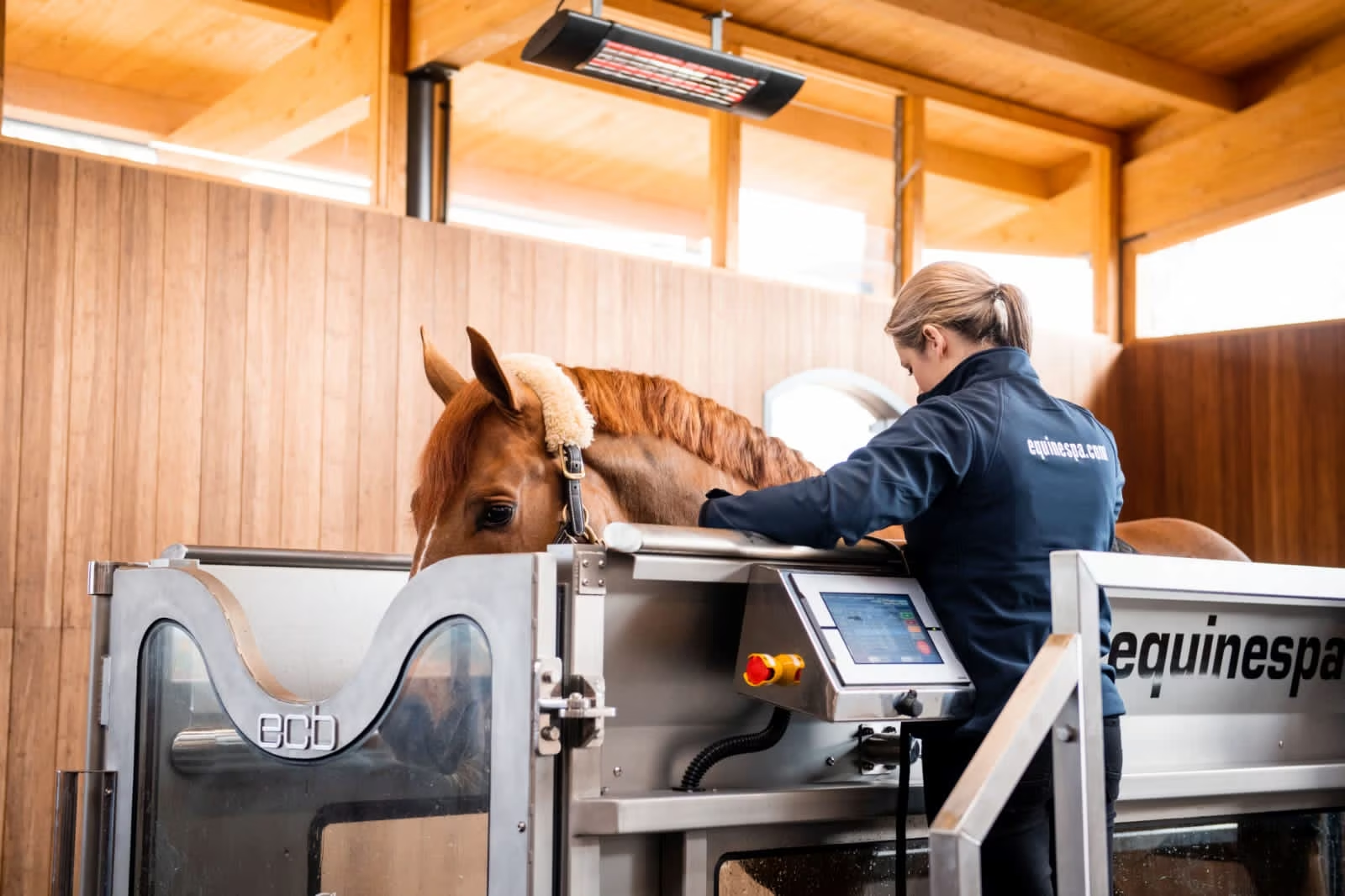
Most equine aqua treadmill manufacturers do not publish unit prices. That is not a quirk — it reflects how the systems are sold. Each install is configured to a facility's room, drainage, electrical, climate, and operating profile, and the quote bundles the unit, the chiller, delivery, installation, training, and ongoing support into one number. A water treadmill is not a piece of stable kit you buy off the shelf; it is a capital asset that should pay for itself inside two to four years if the room is busy.
This guide breaks down what you are actually paying for, what your site has to add on top, and how to model the five-year total cost of ownership against the revenue the unit is built to generate. It is written for facility operators planning a build or expansion — rehab centers, training yards, performance stables, and veterinary hospitals — not for one-off retail buyers.
Three reasons.
First, configuration. An ECB aqua treadmill ships with a marine-grade build, a glass-panelled side viewing window, a 100-program touchscreen, a 12 percent incline, an integrated water-recovery and filtration loop, a chiller, a manure collection harness, and a starter supply of salts and chemicals. Some buyers add a second incline package, an upgraded chiller for hot climates, or a remote-monitoring telemetry module. The base configuration is not the average configuration.
Second, install. Drainage, slab, electrical, and room dimensions sit on the buyer's side of the fence, and they vary by an order of magnitude between a purpose-built rehab building and a converted barn. A manufacturer quoting a public price would have to either over-quote to cover the worst case or undersell and surprise the buyer later. Neither is good for the relationship.
Third, training and after-sales support. ECB includes delivery, installation, training of facility staff, and continued support in every sale. Those line items are real costs the manufacturer absorbs. They are also where a discounted competitor often cuts corners, which shows up two years later when an under-trained operator burns out a chiller or runs the loop without salts.
All of this is to say: when you receive a quote, ask for the bill of materials. The number on the bottom line is less useful than knowing what is inside it.
A like-for-like comparison starts with the bill of materials, not the headline price. Here is what a properly specified equine aqua treadmill quote should include:
If a quote is missing any of these line items, the savings are not real. They will surface later as a separate invoice or as an operating problem.
The unit price is roughly two-thirds of the total project cost on a typical install. The remaining third is site prep, and it is on you.
Room footprint. Plan for a building bay roughly 20 feet long by 12 feet wide with a 12-foot ceiling clear of overhead obstructions. Hudson Aquatic publishes 12 by 20 by 12 as the working room spec for their AquaPacer line, which is a useful planning benchmark across manufacturers. For a built-in unit, pit size varies by site. ECB provides full pit specifications before any construction begins, so do not dig or pour until you have them.
Slab and foundation. Reinforced concrete, load-rated for a horse plus a flooded unit. Have a structural engineer sign off the pour, not a general contractor.
Drainage. A floor drain inside the pit area connected to a sized sump or surface drain. The exact spec depends on local code and whether you are recovering water for reuse.
Electrical. A dedicated 220-volt single-phase or 3-phase circuit (region-dependent), sized to the chiller, drive, and pumps. Run conduit before you pour.
Water supply. Pressurised cold water within reach of the unit, plus a softener if you are on hard mains water. Salt scale on a chiller coil is an expensive lesson.
Ventilation. Industry design guidance for equine rehab buildings calls for four to six air changes per hour in dry rooms and more for wet rooms — EquiManagement's design write-up on equine rehab facilities is a good reference.
A rough planning rule: budget site prep at 30 to 50 percent of the unit price for a new-build bay in good ground, and at 60 to 100 percent for a barn conversion with poor drainage. Get a real number from a local contractor before you sign anything — placeholder figures here would mislead more than help.
The unit price is the visible cost. Over five years, the running costs add up to a non-trivial second number you should model before you commit. The main line items:
A high-volume rehab site running 15 to 20 horses a day will see total operating cost per session settle in the low double-digit dollars/pounds — well inside the session pricing the market will bear. Exact figures are configuration- and tariff-dependent; ask ECB for a worked example for your climate and operating profile.
This is the part most buyers underweight. A water treadmill is not a stable amenity. It is a billable treatment chair.
The throughput benchmarks come from ECB's own client base, on the record:
A reasonable planning number for a busy commercial rehab site is 12 to 20 treatments per day, six days a week. Market session pricing varies by geography:
We are not going to publish a payback-period number we cannot source. What we will say plainly: the testimonials in ECB's review archive are unusually direct on revenue.
"The ECB Equine Spa has undoubtedly been the most profitable, most widely used piece of equipment in the facility." — Brenda Mcduffee, The Sanctuary, Ocala, FL.
"The revenue from the spa actually funded the expansion of our facility and our business is thriving like never before!" — Travis Hunter, Equine Rehabilitation and Conditioning, San Juan Capistrano, CA.
"It has generated a new source of revenue for our business and the operation and maintenance has been very easy and low cost." — Daniel Vernay, Selway Equine Therapy Center, TX.
A 20-treatment-day at $45 per session is $900 of daily revenue from a single bay. Six days a week is $5,400 per week. The math is forgiving even after operating costs, staffing, and depreciation — which is why operators talk about the unit funding facility expansion, not the other way around.
Lead times move with manufacturer order book and shipping route. ECB does not publish a standard lead time, and we will not invent one — contact +44 (0)1451 822969 (UK) or your regional ECB representative for the current quote on your configuration. Plan your room build to finish on a buffer of four to twelve weeks before the unit lands.
ECB does not advertise an in-house financing program. North American buyers typically use third-party equine equipment financing through Farm Credit East, Blue Bridge Financial, or Horizon Farm Credit. UK and EU buyers commonly use asset finance or hire-purchase through their commercial bank. We recommend approaching financing in parallel with the spec conversation, not after — your bank will want a copy of the quote.
A side-by-side that is actually useful goes deeper than the headline price. Score every quote on:
There is no published industry average. The number that matters is your installed number — the bill of materials for the unit plus site prep (slab, drainage, electrical, water, ventilation) at your address. Site prep typically adds 30 to 50 percent on a new build and 60 to 100 percent on a barn conversion. Request a written quote from the manufacturer with every line item itemised, and a parallel quote from a local contractor for the slab, drainage, and electrical work. Ask ECB directly for a configured quote for your facility.
Long enough that it is a planning problem, not a maintenance problem. The very first ECB Equine Spa, installed at Flawborough Equine Centre, Nottingham, in 2001, is still in daily service. Jim Helzer's seven-year reference and Bruce Jackson's "still looks like the day it arrived" (purchased 2009) are typical, not exceptional.
Yes, for a saltwater spa. For an aqua treadmill, the chiller is optional but recommended in hot climates and for high-volume sites where water temperature would otherwise drift through the day. ECB ships the chiller as part of the system; you do not source it separately.
Many ECB installs are conversions. The two non-negotiables are the slab and the ceiling height. If you can pour the pit and you have 12 feet of clear headroom above the running surface, most barns can be adapted. Drainage and electrical are solvable everywhere; the slab and ceiling are not always.
Yes. A common phased approach is to start with the aqua treadmill bay, run for 12 to 18 months while revenue ramps, then add a salt spa room and cryotherapy bay from operating cash flow rather than from initial capital. Phasing typically cuts day-one capital expenditure by 25 to 40 percent.
If you are planning a build, the most useful next conversation is a configured quote with site-prep ranges for your address. Contact ECB Equine through the Contact Us page, or read the horse water treadmill product page for the full feature list and the Rehabilitation Centers solution page for facility planning context.