

The treadmill is the easy part. Most of the work in a UK aqua treadmill project happens before the machine arrives: choosing where it goes, digging the pit or strengthening the floor, getting the right power to the barn and making sure the water has somewhere to drain. Get those right and installation day is quick. Get them wrong and the treadmill sits in a crate while the groundworks catch up.
This guide walks through what a yard, vet practice or rehabilitation centre in the UK or Europe needs to plan before an aqua treadmill goes in. It covers built-in versus floor-mounted models, space and headroom, power, water and drainage, floor loading, planning permission, and how a typical project runs from first call to first session. It's based on the ECB Equine Aqua Treadmill, which our UK team installs and services from Bourton-on-the-Water in Gloucestershire.
Before any measurements, decide what the treadmill is for. The answer shapes almost every later decision.
Write these answers down. They're the first things the ECB team will ask, and they make a site visit far more useful.
The ECB aqua treadmill comes in two installation types. Both use the same treadmill. What changes is how the horse gets on and what your building has to support.
A built-in treadmill sits in a concrete pit, so the horse walks in at floor level. It looks tidy, and many horses find walking in at ground level easier than climbing a ramp.
The trade-off is groundworks. You need excavation, a concreted pit, a slab, drainage, a water supply and a dedicated electrical circuit. Pit size varies by site, and ECB provides full pit specifications before anyone starts digging.
A floor-mounted treadmill sits on an existing floor. There's no excavation, which makes it the faster and simpler choice for many yards, especially if you lease the building or can't dig.
It still needs drainage around the machine, extra space for the ramps, and a level floor rated for the load. More on floor loading below.
If you're building new, or planning a dedicated therapy barn, built-in is often worth the extra groundwork. If you're converting an existing building, or want the treadmill working sooner, floor-mounted usually wins. The ECB team will advise on your site during the visit.
Treadmills take more room than people expect once you allow for the horse walking on and off, handlers and equipment.
Belt dimensions and the final layout are confirmed on your quote, so treat these as planning figures, not construction drawings.
A horse on a floor-mounted treadmill stands higher than it would on the ground. A horse that throws its head up needs clearance. Check roof trusses, lights and beams above the treadmill area before you commit to a building.
Plan where horses wait, where they're tacked up or warmed up, and where they go afterwards. Many yards put the treadmill next to the spa so horses can go straight from work to cold therapy. Leave room for a handler on both sides, and space to walk a horse in hand before and after each session.
These three services decide where in your yard the treadmill can realistically go.
The ECB aqua treadmill runs on single-phase or three-phase electricity, whether it's built in or floor-mounted. Many UK farms and yards have single-phase supply only, so it's worth checking early. If you add the refrigeration package, the chiller adds to the electrical load. Your electrician will need the specification from ECB to size the circuit properly.
You need a mains water supply to fill the treadmill. It holds around 6,000 litres, and the water is filtered and reused for over six weeks rather than changed daily or weekly. So filling is occasional, not daily, but the supply still needs to be there.
When the water is changed, around 6,000 litres needs to go somewhere. Plan the drainage route before the treadmill arrives, for floor-mounted models as well as built-in ones. Sediment access ports beneath the treadmill make routine cleaning easier.
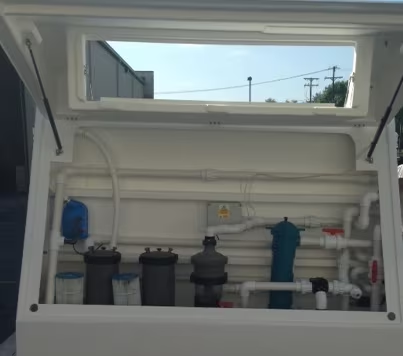
Filtration uses ozone, chlorine and a water clarifier, with automatic dosing and self-cleaning programmes. You'll need a dry, safe place to store treatment chemicals, away from horses.
This is the step that catches people out. The treadmill itself weighs about 2,200 kg. Add around 6,000 litres of water and a horse, and the floor carries a lot of weight in a small footprint.
Before choosing a floor-mounted model, have a structural engineer check the floor. Old concrete in a converted barn may not be rated for the load, or may not be level enough. Fixing that before installation is much cheaper than fixing it afterwards.
For built-in treadmills, the pit and slab are designed for the load from the start, using ECB's pit specification.
Whether you need planning permission depends on your building, your site and your local authority. ECB can't decide that for you, but these points help you start the conversation.
Speak to your local planning authority before you commit to a building or a layout. It's the single best way to avoid delays later.
Every site is different, so ECB confirms lead time and installation dates on your quote. Here's how most UK and European projects run.
In practice, step 4 sets the timeline on most projects. A floor-mounted model in a sound building can move quickly. A built-in treadmill waits on the pit, slab and services being ready.
Buying the treadmill is one cost. Running it is another, and it's worth budgeting for from day one.
Our aqua treadmill cost guide breaks down each of these in more detail.
Most delays on treadmill projects come from a handful of avoidable decisions. Watch for these:
None of these are hard to avoid. They just need to be on the list early, which is why the site visit matters so much.
Have these ready and your first conversation with ECB will be far more useful:
Then see our page on aqua treadmills in the UK and Europe, or the full ECB equine aqua treadmill specifications, and request UK pricing when you're ready.
For a built-in model, plan a bay of roughly 20 ft by 12 ft with 12 ft of clear headroom. A floor-mounted model needs more floor space, because of the ramps. ECB confirms the full footprint for your building on your quote.
No. Built-in and floor-mounted ECB aqua treadmills both run on single-phase or three-phase electricity. Your electrician should size the circuit from ECB's specification, especially if you add the refrigeration package.
It depends on your building, your site and how you'll use it. New buildings usually need permission, and equestrian use is often treated differently from agriculture. Check with your local planning authority before you commit to a building.
The ECB aqua treadmill filters its water with ozone, chlorine and a clarifier and reuses it for over six weeks. Water is changed periodically rather than daily or weekly.
Routine servicing is every three years. Most machines need servicing every year, so this reduces running costs over the life of the treadmill.
Only if the floor is level and rated for the load. The treadmill weighs about 2,200 kg before you add around 6,000 litres of water and a horse, so have a structural engineer check the floor first.
ECB confirms the lead time on your quote. On most projects the site work sets the timeline: a built-in treadmill needs its pit, slab, drainage and power ready before delivery, while a floor-mounted model needs a level floor rated for the load and drainage around the machine.