

The most consistent racing yards in the world all share a quiet operational pattern: they treat recovery as seriously as they treat training. Behind every champion three-year-old colt taking down a million-dollar purse is a daily routine that the public never sees — the long walk back from the gallops, the legs iced or wrapped, the discipline of bringing a horse to a major race fresh, sound, and ready to deliver. Hydrotherapy is now a core part of that routine in the best yards on both sides of the Atlantic, and ECB Equine systems are installed at many of the names that show up in the winner's circle.
This article is for trainers, owners, racing managers, and anyone studying how elite thoroughbred operations build their daily programs. It draws on the operational practices we see across the ECB client base — names including Todd Pletcher in the United States, Charlie Longsdon and Chris Bealby in the UK National Hunt, and the team behind Nancy Takter's Hambletonian-winning Karl. It explains exactly how hydrotherapy gets used through the racing week, what the pre-race and post-race protocols look like, why the timing matters, and what the operational case is for yards considering an installation.
Twenty years ago, hydrotherapy in a racing yard meant cold-hosing in the wash bay and ice boots after a fast piece of work. The legs got cold. The job got done. But the modality was inefficient — labor-intensive, limited to one limb at a time, dependent on the diligence of whoever was holding the hose, and impossible to standardize across a string of fifty or a hundred horses.
Three things have changed. The marginal-gains mindset has crossed from cycling and Formula 1 into top-level racing operations — the head trainers now think of recovery as a controllable performance variable, not a maintenance task. The data has caught up — the research literature on cold hydrotherapy, hydrostatic compression, and water treadmill conditioning now supports clinical and performance applications that were anecdotal a decade ago. And the economics have moved — the cost of injury, lost training days, and missed targets in a million-dollar campaign dwarfs the cost of installing the equipment that prevents them.
The result: every top National Hunt yard in the UK now has either a spa, a water treadmill, or both. Most Grade 1 flat operations in the US and Europe run the same kit. And the trainers who run these systems integrate them into the daily routine with the same discipline they bring to feeding, shoeing, and exercise.
The shape of the day matters because hydrotherapy timing matters. Cold applied at the right point in the recovery cycle compresses recovery; cold applied at the wrong time wastes the modality.
Morning gallops or canter work. The horse finishes the piece of work, walks back to the yard, untacked, washed off. The window for acute cold therapy is the first 30 to 90 minutes after fast work, when the inflammatory cascade is initiating and lower-limb microtrauma is fresh.
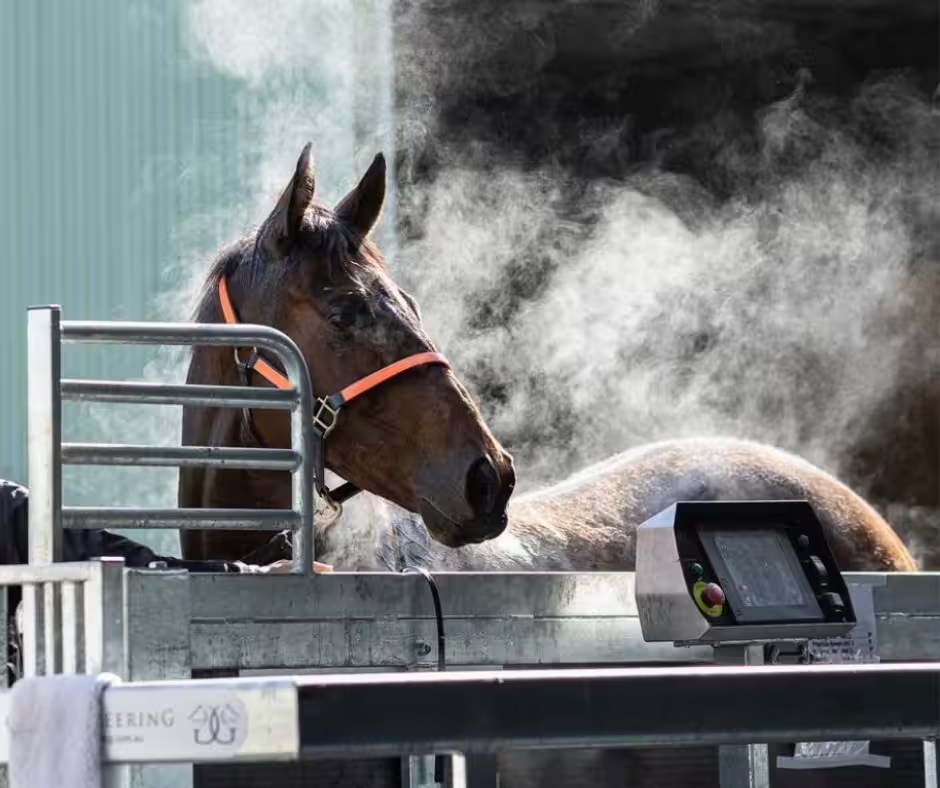
First hydrotherapy session — the ECB Equine Spa. Many top yards move the horse from the wash bay straight to the spa. Ten to fifteen minutes in 2°C saltwater delivers cold, hydrostatic compression, and salt — all four limbs at once. The horse stands quietly. One handler manages the unit; the rest of the yard staff continues with the next horse off the gallops. The throughput is dramatic — a single spa handles 30+ sessions per day in a high-volume operation.
Mid-morning to lunch. Routine yard work — grooming, picking out, hay nets. The legs have already been treated; any developing heat from a hard piece of work has been managed before it had a chance to compound.
Afternoon. Light work for the horses needing a stretch, hydrotherapy time for any specific cases that need it — a sore fetlock, a tight back, a targeted cryo session on a known lesion. ECB INSTANTCRYO is the second-line tool here, applied to specific structures rather than the whole limb.
Evening. Final check, late hay, lights off. The horse goes into the night already substantially recovered from the morning's work — not waiting to recover overnight.
The week before a major target race is the most carefully managed week in the yard. Hydrotherapy is part of that week, used with precision.
Race week minus seven to four days. Standard hydrotherapy program continues. The horse is doing its last meaningful pieces of work. The spa is doing its routine job — managing the post-work inflammation that always accompanies hard training, even on a sound horse.
Race week minus three to two days. Lighter exercise. The spa continues as the primary recovery tool. Water treadmill work, where used, drops out of the program at this point — the horse needs to be fresh, not fitter.
Race day minus one. A short spa session in the morning if the horse routinely uses one — the body is acclimated to the routine and disrupting it can be counterproductive. No work, light grazing, travel preparation.
Race day. No hydrotherapy before the race. The horse arrives at the track on its normal pre-race protocol, warms up under saddle, and runs.
Post-race, on the day. This is where hydrotherapy earns its keep on the win-or-lose day. As soon as the horse has cooled out and the routine post-race checks are done, into the spa. The race itself is the hardest piece of work the horse has done in months — managing the immediate post-effort inflammation with cold hydrotherapy is the single most impactful recovery intervention available.
A horse running a campaign — three or four targets across a season — depends on the recovery infrastructure between races as much as on the training itself. A horse that recovers cleanly from each race is a horse that arrives at the next target ready to deliver. A horse that does not recover cleanly carries fatigue into the next target and underperforms.
In the days following a hard race, the typical protocol is daily spa for the first three to five days, light exercise (in-hand walking, easy hacking), and careful monitoring of any limb that came out of the race with heat. Any specific structure of concern gets targeted attention — typically with INSTANTCRYO or, for whole-limb edema, extended spa time.
By day seven post-race, the horse is back on the regular training program. By the time the next target is in view, the horse has not just recovered but has been managed through the recovery period with discipline. Charlie Longsdon's yard runs a notably consistent recovery protocol across his National Hunt string — one of the operational signatures of a yard that wins regularly with the same horses year over year.
Outside of race-day racing, the other place hydrotherapy delivers measurable returns in racing operations is in the sales-prep cycle. Yearlings being prepared for the major sales — Keeneland, Tattersalls, Inglis, Magic Millions — need to arrive looking the part. Topline, condition, soundness, and a quiet workable temperament are all on display, and the people doing the inspection know what they are looking at.
Water treadmill work in sales prep does several things at once. It builds topline visibly. It improves cardiovascular condition without the impact load of fast track work — which on a developing yearling musculoskeletal system matters. It produces a quiet, work-ready horse that is used to handling a controlled environment. The visible muscle development the treadmill creates is one of the reasons consignors who run treadmill programs report stronger sale prices on prepared yearlings — see our published yearling prep case study from Ali Foye at Gundy Park for one detailed example.
The Cian O'Connor operation at Karlswood — featured in our news section after the centre's opening — uses both the ECB Spa and the water treadmill across the program. The same equipment that supports the top show jumping string also supports the development of the next generation of horses coming through the system. Read about the Karlswood facility opening for the operational context.
The longest-running ECB clients are the most useful reference. Todd Pletcher's operation has used the ECB Spa for years — the 2019 Breeders' Cup Classic with Vino Rosso was one of many high-profile wins by a horse running through that program. Read the 2019 Breeders' Cup write-up for that result, and our coverage of Karl's 2024 Hambletonian victory for a more recent example with trainer Nancy Takter. The pattern across decades of installations is the same: yards that integrate hydrotherapy as core operational discipline produce horses that are sound when they need to be sound, deliver on the day, and run more races per career.
The same operational pattern applies in the UK National Hunt market. Charlie Longsdon, Chris Bealby, and the other yards running ECB equipment treat the spa as a daily-use tool, and the campaigns they assemble show the result — multiple targets per season, low rate of mid-season injury layoffs, horses that return to peak form between races.
For yards considering an installation, the decision rarely comes down to "does hydrotherapy help horses recover" — at this stage of the industry, the answer to that is well-established. The decision comes down to whether the yard's volume justifies the capital investment.
Operational throughput. A spa running 30+ sessions per day across a 50- or 100-horse yard pays for itself on labor cost reduction alone. The wash-bay-and-cold-hose routine that the spa replaces is genuinely labor-intensive at scale.
Injury rate. The yards that have installed hydrotherapy systems and run consistent programs report measurable reductions in soft-tissue injury rates over the operational baseline. Even small percentage improvements at racing-yard scale translate into substantial financial returns.
Days-in-training metric. A horse that is in training is generating progress. A horse that is on the easy list is generating cost. Hydrotherapy as a routine recovery tool moves the days-in-training metric in the right direction.
Career length. Horses managed through a sound recovery program have measurably longer competitive careers. For breeze-up and selling yards this is a direct value driver; for owner-trainers it is the difference between three productive seasons and seven.
For more detail on the financial case, see our published year-one ROI breakdown for hydrotherapy investment and the aqua treadmill cost buyer's guide.
The yards that struggle to get full value from their hydrotherapy equipment almost always make one of three mistakes.
Treating the spa as optional. If hydrotherapy is part of the program for some horses and not others, the discipline of the program never establishes. The horses that need it most are not always the ones who get used to it first.
Using hydrotherapy only when something is wrong. The therapeutic value of the spa is highest as a routine post-work recovery tool. Reserving it for "problem cases" misses 90% of the value.
Skipping the operator training. The spa is simple to operate and the treadmill takes a few sessions to master. But the discipline of running both at full effectiveness requires trained staff. ECB provides training with every installation — use it.
Both, but routine is the bigger use case. The yards running at the top of the international rankings — Pletcher, Longsdon, Bealby, Takter, the major flat operations across Newmarket and Chantilly — use the spa as a daily recovery tool for the working string. Injury cases get treated, but the daily routine is the higher-leverage application.
No, used appropriately. The spa and treadmill resolve acute post-work inflammation; they do not mask underlying lameness. A horse with a developing injury still shows in trot-up, in fast work, and in lameness examination. Hydrotherapy is a recovery tool, not a diagnostic veil.
Ice boots cool the area in direct contact with the ice and require dedicated time per limb. The spa cools all four limbs at once, adds hydrostatic compression that ice boots cannot deliver, and adds the therapeutic effect of salinity on the skin and surface tissues. For a busy yard, throughput alone is the operational difference; for the individual horse, the multi-modal effect of the spa is therapeutically superior.
As soon as the horse has cooled out from the race, completed the routine post-race checks, and is settled — typically 30 to 90 minutes post-race. The window for cold therapy is widest in the first two hours; the sooner you can apply it, the more effective it is.
No. Hydrotherapy is non-pharmacological and is not subject to anti-doping restrictions. The spa, water treadmill, and localized cryotherapy are all permitted within standard racing rules. Specific competition formats may have detailed protocols — always check with your governing body — but the modalities themselves do not violate anti-doping regulations.
The financial case starts to make sense at around 25 to 30 horses in training, depending on operational profile and pricing model. Smaller yards often access hydrotherapy through neighboring facilities or training centers; larger yards install in-house for the throughput, control, and integration with daily routine.
The trainers who use hydrotherapy consistently report better days-in-training metrics, lower injury rates, and longer competitive careers per horse. The direct attribution to specific race wins is harder to isolate — there are too many variables — but the operational pattern is clear at the top of the sport. Every major training operation we work with has hydrotherapy embedded in the daily program.
The yards running ECB equipment include some of the most recognized names in international racing. The team has supported installations across racing facilities in the US, the UK, Ireland, France, Australia, Dubai, and beyond — over 500 facilities worldwide. If you are considering an installation for your own operation, the next step is a conversation about your specific yard, your discipline, your volume, and your existing routine.
Explore the Solutions for Performance Stables page for the operational picture, the Solutions for Training Facilities page for the high-volume racing context, or the ECB Equine Spa and Aqua Treadmill pages for full specifications. To talk to the team about an installation for your yard, contact us through the contact page — or call +1 973-383-5511 (Americas) or +44 (0)1451 822969 (UK and rest of world).