

Ask three manufacturers what an equine cryotherapy machine costs and you will get three answers that are difficult to compare, because they are quoting different things. One includes the applicator set, one does not. One includes training and commissioning, one bills it. One is quoting a device with metered delivery and thermal imaging, one is quoting a hose and a trigger. The spread between the cheapest and the most expensive equine cryotherapy system on the market is very wide, and almost none of that spread is margin.
ECB does not publish prices, for the same reason we do not publish a price for a water treadmill: what a facility actually pays depends on configuration, applicator set, training requirement, territory and installation, and a headline number that ignores those is a number that misleads. What we can do — and what this guide does — is tell you exactly what moves the price, roughly how much each factor moves it relative to the others, what it will cost you to run, and how to compare two quotes that look nothing alike.
This is written for facility owners, veterinary practices and yard managers making the purchase decision. If you want a figure for your specific configuration, ask us for one — you will get it quickly and without a sales sequence attached.
Six factors account for most of the variation between systems. They are listed roughly in order of how much they move the number.
1. Delivery method and the cold source. This is the largest single determinant. Systems fall broadly into three families: CO₂ systems, which achieve very low surface temperatures using food-grade carbon dioxide from a siphon cylinder; nitrogen-based systems; and refrigerated-air or compressor-driven devices, which use no consumable gas but reach much less extreme temperatures. The engineering cost, the achievable temperature and the running cost profile differ substantially between these, and comparing a CO₂ unit against a chilled-air unit on price alone is comparing two different therapies.
2. Control precision and instrumentation. A device that simply releases gas is far cheaper to build than one that meters the dose, regulates delivery and shows you what you actually applied. Integrated thermal imaging — which lets the operator see surface temperature at the treatment site in real time and confirm the target was reached without overshooting — sits at the top of this range. Whether that is worth paying for depends entirely on who will be holding the applicator. In a veterinary clinic where treatments must be documented and defensible, instrumentation is not a luxury. In a yard where one experienced person treats the same six horses, it matters less.
3. Applicator and nozzle set. This is the factor most often left out of a headline price and most often needed. A fetlock, a hock, a saddle-pad area and a distal tendon are different shapes requiring different applicator geometry, and a system supplied with one general-purpose nozzle will not treat all of them well. Ask what is included and price the full set you will actually use — on some quotes this is a material addition rather than an accessory.
4. Build specification for daily commercial use. A unit used twice a week by one careful person and a unit used fifteen times a day in a busy clinic are different engineering problems. Hose quality and thermal-cycling tolerance, connector durability, valve life, chassis robustness and ingress protection all separate a professional device from a light-duty one, and none of it is visible in a photograph. This is the factor buyers discover eighteen months later rather than at purchase.
5. Portability and configuration. Trolley-mounted, fully portable, or fixed installation. A genuinely portable unit that one person can move between stables without help is worth a great deal operationally in a large yard — and costs more to build than a static equivalent.
6. Territory, warranty and what surrounds the box. Two identical machines quoted in two countries are not the same purchase. Training at handover, commissioning, warranty duration and terms, in-territory service cover, and guaranteed parts lead times are all real costs to the supplier and real value to you. A quote that excludes them is cheaper on paper and frequently more expensive in year two.
Used equine cryotherapy units come up regularly, usually when a facility closes or upgrades, and they can be a sound purchase. The discount is real. So are the risks, and they are specific.
What to inspect. Hoses along their full length, at the connector ends especially, for stiffness, cracking and perished sections — repeated extreme thermal cycling is hard on flexible components. The applicator body and nozzle for damage and blockage. Valves and seals for leakage: a CO₂ system that leaks does not fail dramatically, it simply consumes more gas and under-delivers, which is a fault you will pay for daily and may not notice for months. Insist on seeing the unit connected to a live cylinder and running a complete treatment cycle. A seller who will not demonstrate that has answered your question.
Calibration. If the unit meters delivery or carries thermal imaging, ask when it was last calibrated and by whom. An uncalibrated device delivering an unknown dose to a horse's leg is not a therapeutic instrument, and recalibration — if it is even offered for that model — is a cost.
What a used unit realistically saves. Less than the discount suggests, once you add recommissioning, a replacement hose and applicator set if the originals are tired, calibration, and the fact that most manufacturer warranties do not transfer. Work out the total, not the sticker.
What voids support. Unauthorised modification, self-repair, non-original components and use of gas outside the specified grade or cylinder configuration will generally end any residual manufacturer support. So, frequently, will buying outside the supported service territory. Establish the model's support status with the manufacturer before you travel to view it — most reputable manufacturers will tell you honestly, and it is a phone call that saves a wasted day.
Refurbished from the manufacturer is a different proposition from used from a dealer or a private seller. A factory refurbishment usually means replaced wear components, verified calibration and some warranty. If it is available for the model you want, it is often the best value point on the curve. Our guide to buying used equine hydrotherapy equipment covers the wider inspection process across spas and treadmills as well.
The purchase price is the part everyone compares. The running cost is the part that determines whether the machine is affordable in year three, and it is largely predictable.
Consumable gas. For a CO₂ system this is the dominant recurring cost and it is straightforwardly calculable. Gas consumption per treatment is a function of delivery rate and treatment duration, both of which the manufacturer can state. Multiply by treatments per week and by your local cost per cylinder, and you have an annual figure that is accurate rather than estimated. Do this before you buy, using your local gas price — CO₂ cost varies substantially by region and by supplier, and a system that is economical in one market can be noticeably less so in another. Confirm too that you can reliably source food-grade CO₂ in the correct siphon configuration locally; this is not the same product as general industrial or welding gas.
Cylinder logistics. Rental or deposit on cylinders, delivery charges, and the storage and handling requirements that come with pressurised gas on site. Small individually, real annually, and occasionally a planning constraint.
Power. Modest for CO₂ systems, which need little more than control electronics. Substantially higher for compressor-driven chilled-air devices, where the machine itself generates the cold. This is the point at which the two families' running costs diverge in the opposite direction from their consumable costs, and it is why the comparison has to be done over a year rather than per session.
Maintenance and wear parts. Hoses, seals, applicator components and periodic servicing. Ask for the recommended service interval, what a service comprises, what it costs and who performs it in your territory.
Calibration. If the device is instrumented, budget for periodic recalibration.
Operator time. A 30-to-90-second treatment plus handling is a very small labour cost per session — one of localised cryotherapy's genuine commercial advantages over modalities requiring two handlers and a half-hour slot.
Localised cryotherapy units are mechanically simpler than spas or water treadmills, with no chiller, no pumps and no large body of water working on the components. Well maintained, with hoses and seals replaced on schedule and gas of the correct grade, a professional unit stays in commercial service for many years.
What actually shortens life, in order: wrong gas grade or cylinder configuration; hoses left connected under pressure and not inspected; physical damage to the applicator from being dropped or trodden on; and deferred servicing. None of these are age-related, which is why service history matters far more than year of manufacture when assessing a second-hand unit.
Do not evaluate a cryotherapy purchase on price. Evaluate it on cost per session against what a session is worth to you, over a defined horizon. The arithmetic is simple and it is the same regardless of which manufacturer's numbers go into it.
Step 1 — total cost of ownership. Over five years: purchase price, plus applicator set, plus training and commissioning, plus annual gas consumption × 5, plus cylinder charges × 5, plus servicing and wear parts × 5, plus calibration × 5. Call this TCO.
Step 2 — realistic sessions. Treatments per week × 50 weeks × 5 years. Be honest here, and be conservative: this is where business cases fail. Count the horses you actually treat now, not the ones you hope the machine will attract.
Step 3 — cost per session. TCO ÷ total sessions. This is the only number that lets you compare a cheap unit with high gas consumption against an expensive one with low consumption, and it routinely reverses the ranking the purchase prices suggested.
Step 4 — the value side. For a facility that charges for treatment, this is the per-session fee, and payback is simply the point at which cumulative fees exceed TCO. For a facility that does not charge separately — a private yard, a racing operation — the value is different but no less real: veterinary interventions avoided, training days not lost, and the ability to treat a horse in the stable without interrupting its programme. Put a number on those for your own operation, because they are usually larger than the fee-per-session model would suggest.
Step 5 — sensitivity. Re-run steps 2 to 4 at half your expected utilisation. If the purchase still works at half volume, it is a robust decision. If it only works at full volume, you are betting on a forecast. Our first-year hydrotherapy ROI analysis works through this pattern in detail across modalities.
Whole-body cryotherapy chambers are well established in human sports medicine, and the question of an equine equivalent comes up regularly. In practice, equine cryotherapy is overwhelmingly localised, for reasons that are practical rather than ideological.
A horse is large, and cooling its entire body surface requires a chamber, a great deal of energy, and an animal willing to stand in it. The therapeutic target in almost every equine case is a specific structure — a tendon, a fetlock, a suspensory branch, an area of the back — and treating the whole animal to reach one structure is inefficient in every sense. Localised delivery reaches a far lower temperature at the target site than any whole-body system achieves across a whole body, in seconds rather than minutes, in the stable rather than in a dedicated room, with no chamber to build and no environment to condition.
There is a legitimate discussion in human medicine about systemic effects of whole-body exposure. In equine practice, the case for localised treatment is strong enough, and the practical obstacles to whole-body treatment substantial enough, that localised is the established standard. If a supplier is quoting you a whole-body equine system, ask specifically what surface temperature it achieves at the target structure and how that compares with a localised device.
Print these. The answers, taken together, tell you more than any specification sheet.
1. What exactly is in the quoted price — applicators, hoses, trolley, training, commissioning, first service?
2. What surface temperature does the system achieve at the treatment site, and how is that verified?
3. What is the gas consumption per treatment, and what gas grade and cylinder configuration does it require?
4. Which applicators do I need for the structures I actually treat, and what do the additional ones cost?
5. What is the warranty duration, what does it cover, and does it transfer if I sell the unit?
6. What is the service interval, what does a service cost, and who performs it in my country?
7. What are the current lead times for hoses, applicators and seals — in days, to my address?
8. What training is included, for how many people, and is refresher training available when staff change?
9. Are there installation or site requirements — power, gas storage, ventilation, handling regulations?
10. Can you put me in touch with a facility running this unit that I can visit or call?
Question 10 is the one that separates suppliers. A manufacturer with satisfied customers will connect you to one without hesitation.
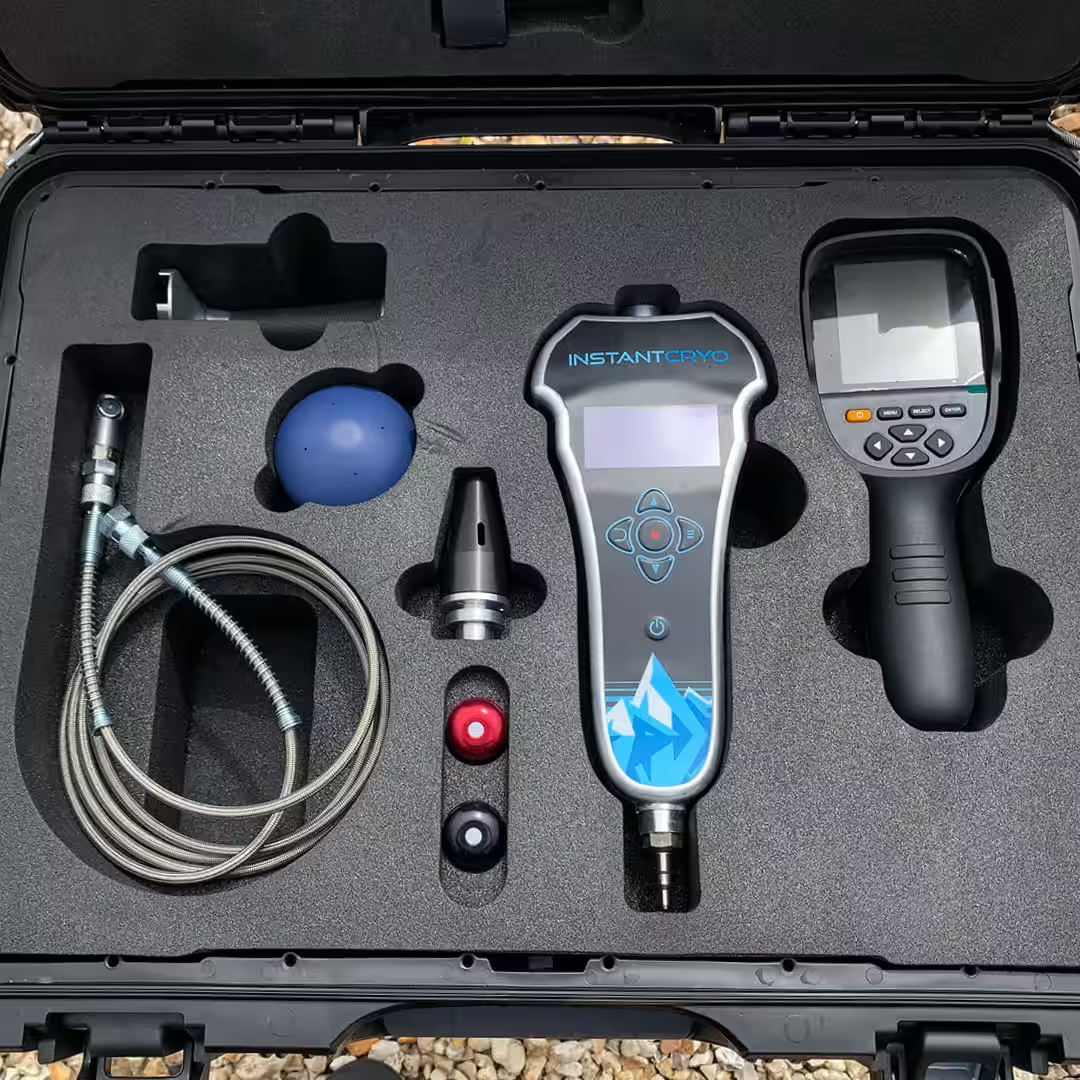
ECB INSTANTCRYO is a portable localised system using food-grade CO₂ from a siphon cylinder, delivered through a precision applicator at approximately -78°C, bringing the skin surface to around 4°C within 30 seconds, in a treatment of 30 to 90 seconds per site. It is configured with specialised nozzles for different anatomical targets and is available with HD thermal imaging so the operator can see the surface temperature reached at the treatment site rather than inferring it. It is designed for daily commercial use in clinics, rehabilitation centres and racing yards. For FEI horses, remember that the FEI Veterinary Regulations prohibit cryotherapy at FEI Events and in the 5 days before them (Article 1065.3).
On the six price drivers above it sits at the professional end: CO₂ delivery for genuine extreme cold, real instrumentation, a full applicator set, portability, and a build intended for repeated daily use rather than occasional use. It is not the cheapest way to put a cryotherapy device in a yard, and where a facility's honest utilisation is low we will say so. Where a facility is treating daily, the cost-per-session arithmetic in the section above is what makes the case, and it is arithmetic we are happy to run with you using your own numbers.
For how localised cryotherapy compares with cold saltwater hydrotherapy on tendon cases specifically — a genuinely different tool for an overlapping problem — see our detailed comparison of the two modalities. For the clinical application in a veterinary setting, see equine systems for veterinary clinics, and for a worked treatment example, localised cryotherapy for saddle sores.
There is no single figure, and any published one would be misleading, because the spread across the market is wide and driven by real engineering differences rather than margin. What determines your price, in order of impact: the delivery method and cold source (CO₂, nitrogen or refrigerated air); the level of control precision and instrumentation, with integrated thermal imaging at the top of the range; the applicator and nozzle set you actually need, which is frequently excluded from headline quotes; build specification for daily commercial versus occasional use; portability; and what surrounds the machine — training, commissioning, warranty, in-territory service and parts lead times. ECB quotes against a specific configuration; tell us what you treat and how often and you will get a figure quickly.
It can be, if you inspect properly and establish support first. Before travelling to view one, give the manufacturer the model and serial number and confirm the model is still supported, that hoses, seals and applicators are available, and that your location is inside a supported service territory. At the viewing, insist on seeing the unit connected to a live cylinder running a complete treatment cycle — a leaking CO₂ system does not fail visibly, it just consumes gas and under-delivers. Inspect hoses along their full length for stiffness and cracking, check the applicator for damage, and ask when the device was last calibrated. Remember that most manufacturer warranties do not transfer, and that unauthorised modification, self-repair or the wrong gas grade will have ended any residual support.
They are calculable rather than estimated, which is why you should work them out before buying rather than after. For a CO₂ system the dominant cost is gas: ask the manufacturer for consumption per treatment, multiply by your treatments per week and by your local cost per cylinder. Add cylinder rental or deposit, delivery charges, periodic servicing and wear parts (hoses, seals, applicator components), and recalibration if the device is instrumented. Power draw is modest for CO₂ systems and substantially higher for compressor-driven chilled-air devices — which is why a year-long comparison, not a per-session one, is the only fair way to compare the two families. Operator time is small: a treatment is 30 to 90 seconds plus handling, needing one person.
Longer than a spa or a water treadmill, because it is mechanically simpler — no chiller, no pumps, no large body of salt water attacking the components. A professional-grade unit, maintained on schedule with hoses and seals replaced when due and the correct gas grade used throughout, stays in commercial service for many years. What actually shortens life is not age: it is the wrong gas or cylinder configuration, hoses left pressurised and uninspected, physical damage to the applicator, and deferred servicing. That is why, when assessing a second-hand unit, a documented service history tells you far more than the year of manufacture.
For equine practice, localised is the established standard, and the reasons are practical. The therapeutic target in almost every case is a specific structure — a tendon, a fetlock, a suspensory branch, a region of the back — so treating the entire animal to reach one structure is inefficient in energy, time and facility terms. A localised applicator reaches a far lower temperature at the target site than any whole-body system achieves across a whole body, in seconds rather than minutes, delivered in the stable with no chamber to build and no environment to condition. If a supplier offers a whole-body equine system, ask what surface temperature it actually achieves at the target structure and compare that directly with a localised device.
If you want a price, the fastest route is to tell us three things: what structures you treat, roughly how many treatments a week, and where you are. That is enough for us to specify a configuration and quote it, and enough for us to tell you honestly if the utilisation does not justify the purchase.
See the ECB INSTANTCRYO equine cryotherapy machine page for the full specification and the detailed feature breakdown, or browse the full product range if you are still deciding between modalities. The spa locator shows facilities running ECB systems worldwide.
Request a quote or a specification conversation through our contact page — or call +1 973-383-5511 (Americas) or +44 (0)1451 822969 (UK and rest of world).