

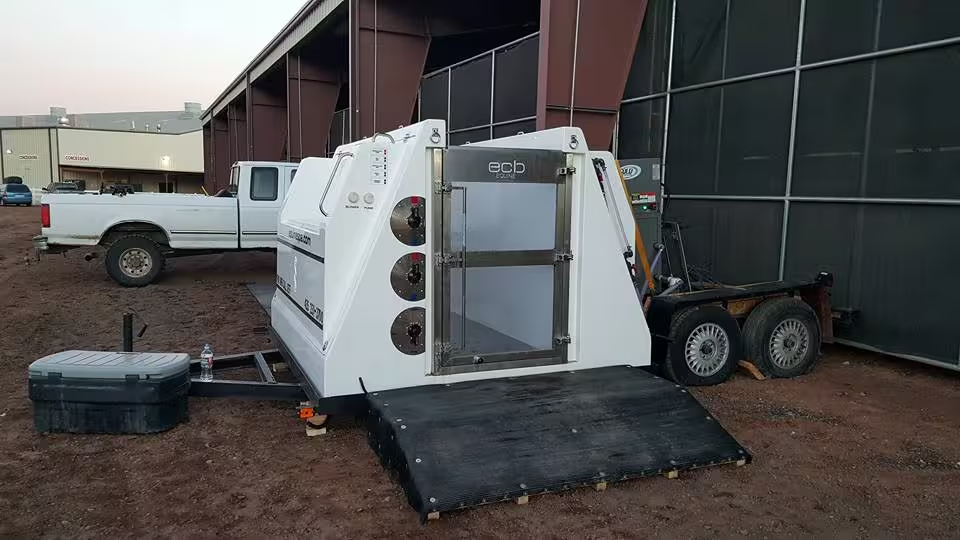
When a horse pulls up sore after a hard piece of work, the trainer's first decision is almost always the same: cold or no cold? The second decision is harder — which cold modality, applied where, for how long, at what cost to the daily schedule. Two of the most clinically defensible answers used in racing yards, performance stables, and rehabilitation centers across the world are cold saltwater hydrotherapy and localized cryotherapy. ECB Equine builds the leading equipment for both — the ECB Equine Spa for cold salt hydrotherapy, and ECB INSTANTCRYO for targeted CO₂ cryotherapy — and clients who run both systems side by side have a clear view of which tool does what. For the wider picture, see our guide to cryotherapy for horses.
This guide is for the people making that decision: head trainers, racing managers, veterinary clinicians, and facility owners who need to know exactly when to put a horse in the spa, when to reach for the cryo unit, and how to design a recovery program that uses both without doubling up.
Both treatments lower tissue temperature to control inflammation, but they reach the tissue very differently. Cold saltwater hydrotherapy uses high-salinity water chilled to roughly 2°C (35°F), circulated around all four lower limbs at once for 10 to 20 minutes. Localized cryotherapy uses food-grade CO₂ delivered through a precision applicator to cool a single defined area (a fetlock, a tendon, a saddle pad area). The gas leaves the applicator at -78°C and brings the skin surface down to roughly 4°C within 30 seconds; a treatment takes 30 to 90 seconds per site.
The contrast matters. Hydrotherapy is whole-limb, low-intensity, long-duration, and works through hydrostatic pressure and salt as much as cold. Cryotherapy is point-source, high-intensity, short-duration, and works through a thermal shock that the body responds to with a vasodilation rebound. You do not pick one because it is "better" — you pick one because the injury and the schedule call for it.
The ECB Equine Spa stands the horse in a closed pool of saltwater at approximately 2°C, with salt concentration roughly ten times that of seawater. Three mechanisms work simultaneously on the lower limbs.
Hydrostatic pressure. The depth of the spa creates a controlled pressure gradient that compresses the soft tissues from the hoof upward. The compression pushes interstitial fluid out of inflamed regions, accelerating the clearance of swelling and metabolic by-products from hard work. Trainers who use the spa every morning after fast work see distal-limb swelling resolve in a fraction of the time it takes with cold-hosing alone.
Cold. At 2°C, cutaneous vasoconstriction is profound, which reduces blood flow to acute inflammatory sites, dampens the inflammatory cascade, and produces a measurable analgesic effect. Importantly, the cold is delivered uniformly to all four limbs at once — not just the limb the trainer is worried about.
Salt. The hyper-saline environment is osmotic, drawing fluid out of damaged tissues and through the skin's natural barriers. The salt also acts as a mild antiseptic, which is part of why the spa is so effective for surface conditions like minor mud fever, wounds in the early stage of healing, and cracked heels.
Sessions are short — typically 10 to 20 minutes once or twice daily — and the horse stands quietly without sedation. There is no ridden compensation, no missed training day, no specialist required to operate the unit.
ECB INSTANTCRYO is a different tool for a different problem. The system uses food-grade CO₂ delivered from a siphon cylinder through a precision applicator. When the applicator is held against the target area, the gas leaves the applicator at approximately -78°C and drops the skin-surface temperature to around 4°C within 30 seconds. A typical treatment is 30 to 90 seconds per site, applied directly to the area of concern.
The physiology is not the same as the spa. The thermal shock triggers a reflex sympathetic nervous system response — the body interprets the sudden drop as a threat to tissue viability and responds with strong analgesia, anti-inflammatory cascade modulation, and a powerful vasodilation rebound when the applicator is removed. The rebound is the therapeutic phase: nutrient-rich blood floods back into the treated area, accelerating local healing.
Because the treatment is so brief and so targeted, INSTANTCRYO is the right answer when you need to treat a single inflamed structure — a strained suspensory branch, a sore fetlock, a localized back pain — without taking the horse out of work. The unit is portable and the treatment can be delivered in the stable. For FEI horses, note that the FEI Veterinary Regulations prohibit cryotherapy at FEI Events and in the 5 days before them (Article 1065.3), so plan treatments outside that window.
This is the question most trainers want answered, and the honest answer is: they win at different points in the same injury.
In the first 48 to 72 hours after an acute soft-tissue insult — a hot tendon coming off the gallops, an over-extended fetlock, a misstep on the lunge — cold is universally indicated. Both modalities reduce edema and pain. The spa has the advantage of delivering uniform cold across the entire distal limb without requiring the handler to hold an applicator in place, and the hydrostatic pressure adds a mechanical benefit that cryotherapy cannot replicate. For an acute, swollen, generally inflamed limb, the spa is the default.
From day three onward, when the acute swelling has been controlled but the injured structure still needs attention, INSTANTCRYO becomes the more precise tool. You can target the specific lesion — the medial branch of the suspensory, the proximal aspect of the SDFT, the affected sesamoid — without continuing to cool tissue that no longer needs cooling. The rebound vasodilation drives fresh blood into the healing structure specifically.
Stables that have both tools typically run an acute-phase spa protocol for the first three to five days, then transition to INSTANTCRYO once the diagnosis is precise and the swelling is down. Suspensory ligament injuries, which account for up to 46% of limb injuries in performance horses, respond particularly well to this layered approach. Read more in our guide on suspensory ligament injuries and water treadmills.
Move beyond tendons and the picture changes again. Here is how the two systems compare across the most common presentations a busy yard sees in a typical week.
The two systems sit at different points on the capital-and-operations curve, and a facility's decision often comes down to volume.
The ECB Equine Spa is a fixed installation with a footprint roughly equivalent to a large stable, plumbed water and power, and a chilling unit that needs scheduled maintenance. It is a meaningful capital purchase but the cost per horse per session drops sharply as throughput rises. Yards running 30 or more spa sessions per day amortize the equipment quickly. The spa is built to handle that volume — see our year-one ROI breakdown for hydrotherapy investment for facility-level numbers.
ECB INSTANTCRYO is a portable system. The unit moves between stables, and the operating cost is the CO₂ cylinder. There is no installation, no plumbing, and no fixed footprint. A handler can deliver targeted treatment to a horse standing in its own box. The cost per treatment is low and predictable. For yards that need precise intervention rather than high-throughput recovery, INSTANTCRYO is far easier to justify on day one.
Most serious facilities — racing yards, top show jumping stables, rehabilitation centers — eventually run both. The two systems do not compete; they cover different operational needs.
The questions to ask, in order:
None of this replaces a veterinary diagnosis. Both systems are most powerful when the treatment plan is built around imaging and clinical examination — and both are most often misused when the team reaches for them before the diagnosis is clear.
The clinical literature on equine hydrotherapy has matured significantly over the last decade. Studies on water treadmill use have shown measurable increases in epaxial muscle profile in horses on consistent inclined-resistance programs (see our research summary on epaxial muscle development). Cold hydrotherapy is well-documented for reducing acute inflammatory markers and accelerating return-to-work timelines in tendon injuries. Localized cryotherapy has a longer track record in human sports medicine but is gaining clinical evidence in the equine field, particularly for soft-tissue and joint pathology.
What the evidence does not yet do is rank one modality definitively against the other for the same injury. It is also unlikely to — the two tools do different mechanical work on the tissue, and the question is not which one is "better" but which is appropriate for the specific case at hand.
Yes, and many high-performance yards do exactly that. A typical sequence is a 10-minute spa session in the morning after work to manage general post-exercise inflammation across all four limbs, followed by a targeted 60-second INSTANTCRYO treatment on the specific area of concern in the afternoon. Always allow the limb temperature to return to baseline between treatments — generally 2 to 4 hours.
The operating temperature is approximately 2°C (35°F), maintained by an integrated chilling unit. The saltwater is roughly ten times the salinity of seawater, which lowers its freezing point and allows it to circulate at temperatures that would freeze fresh water. The salt is also therapeutic in its own right.
Yes, when the applicator is used as designed. The treatment time is short (30 to 90 seconds) and the cooling effect is largely confined to the skin and immediate subcutaneous tissue. The body's thermoregulatory response prevents deeper structures from reaching damaging temperatures. INSTANTCRYO uses food-grade liquid CO₂ cylinders fitted with a siphon tube.
Yes. The ECB Spa is used routinely as a daily recovery tool in racing yards on race day and the day before. For FEI horses, cryotherapy is prohibited at FEI Events and in the 5 days before them (Article 1065.3, FEI Veterinary Regulations 2026), so finish INSTANTCRYO treatments before that window. Both systems are non-pharmacological and do not interact with anti-doping regulations.
No, but you should design your treatment protocols with your veterinarian and ensure your operating staff are trained. ECB provides training with every installation. Both systems are designed for daily use by experienced grooms and handlers, not specialist clinicians.
If your facility handles a high volume of horses in regular work — a racing yard, a sales prep facility, a busy show jumping yard — the spa pays for itself first because it handles the routine recovery load. If your facility handles fewer horses but treats more complex injuries — a veterinary clinic, a rehabilitation specialist, a small high-end stable — INSTANTCRYO is the higher-leverage first purchase. Most serious operations end up with both within the first 18 months.
Choosing the right hydrotherapy or cryotherapy program for your facility is not a product comparison — it is a workflow decision. The ECB team has helped over 500 facilities worldwide build that workflow, from one-spa private yards to multi-unit rehabilitation centers. If you want to talk through how the two systems would fit into your operation, the next step is a short conversation.
Explore the ECB Equine Spa for full specifications on the cold saltwater system, or visit the ECB INSTANTCRYO equine cryotherapy machine page for the portable unit. To talk to the team about a specific facility or case, request a consultation through our contact page — or call +1 973-383-5511 (Americas) or +44 (0)1451 822969 (UK and rest of world).