

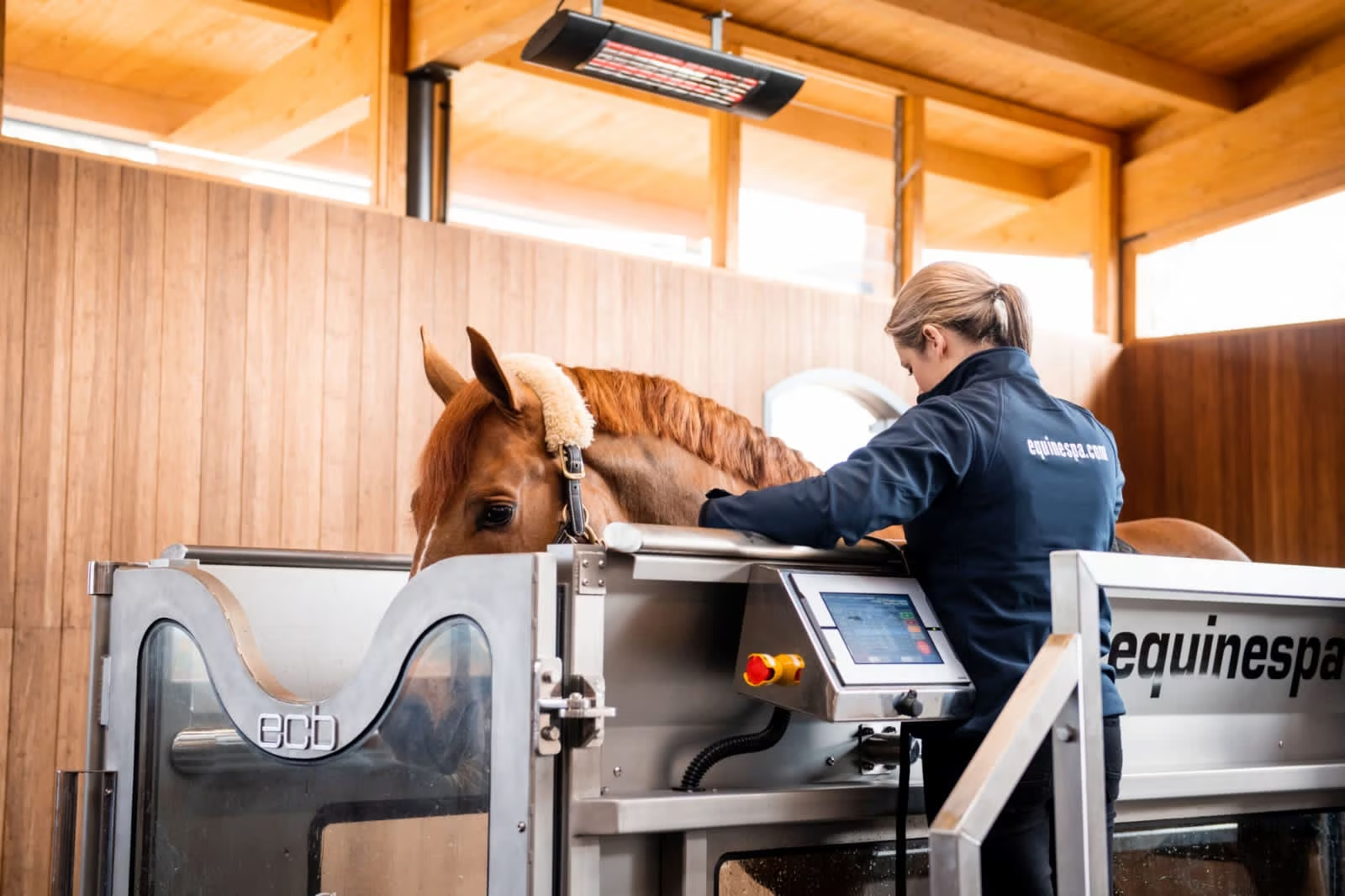
A showjumper, an event horse and a dressage horse can all walk on the same aqua treadmill. They shouldn't get the same session. The jumper needs a strong back and sound hocks for a season of big tracks. The eventer needs a cardiovascular engine that will last ten minutes across country. The dressage horse needs a topline that can carry collection for a whole test.
This guide is for UK and European competition yards that own an aqua treadmill, or are thinking about one, and want to use it properly for sport horses. It covers how water work helps each discipline, how to adapt sessions for showjumping, eventing and dressage, how to plan treadmill work around a competition calendar, and what British guidance says about safe use. If you want a full week-by-week plan, pair it with our 12-week aqua treadmill training program.
For years, aqua treadmills in the UK were mostly found in rehabilitation centres and vet hospitals. That's changed. Competition yards now use them for everyday conditioning, not just for horses coming back from injury.
The reason is simple. Water lets you work a horse hard with less concussion. Buoyancy takes weight off the limbs, while the water's resistance makes the horse lift its legs higher and push harder from behind. You get fitness and strength work without the pounding of a gallop or the wear of endless roadwork.
The British weather helps make the case too. When the gallops are frozen or the arena is waterlogged in February, a horse on a treadmill indoors can keep its fitness programme on track.
ECB Equine works with competition yards across the UK and Europe from our office at Bourton Hill Farm in Gloucestershire. Keysoe International has run an ECB equine spa and aqua treadmill for two years. Wellington Riding has an ECB aqua treadmill going in this December. Olympic showjumper Cian O'Connor has used ECB spas for more than 10 years and had his first ECB water treadmill six years ago; his new spa, aqua treadmill and INSTANTCRYO go in this December.
Before adapting sessions by discipline, it helps to know what you're actually training. Water depth, speed and incline each change the work.
Shallow water, around fetlock to mid-cannon, adds resistance and makes the horse pick its feet up. Deeper water, towards the stifle, adds buoyancy and takes more weight off the limbs while still asking the horse to push through the water. The ECB aqua treadmill adjusts water depth up to 104 cm, and fills to 60 cm in about two and a half minutes.
Most conditioning work happens at walk. The ECB treadmill runs up to 12 km/h, which covers walk and trot. Trot work should only come in once the horse is fit, sound and working cleanly at walk.
Incline shifts the effort to the hindquarters and back. The ECB treadmill offers 0 to 12% incline in 1% steps, so you can add it gradually. Incline work is where much of the topline development happens, and it's also where you need to watch the hocks most closely.
You can't improve what you don't measure. The touchscreen stores up to 1,000 individual programmes, so each horse can have its own settings saved. The optional heart rate and horse weighing system logs each session, which gives you and your vet hard numbers rather than impressions. Large safety glass panels on both sides let you watch the gait while the horse works.
A showjumper's job puts heavy, repeated load on the hind end and the back. Every fence is a push off the hocks and a landing through the front legs. Treadmill work for jumpers is mostly about building the strength that carries that load, while protecting the joints that take it.
Moderate depth work at walk, around mid-cannon to mid-stifle, builds the muscles that lift the back and engage the hindquarters. Short, gradual incline blocks add to that once the horse has a base.
Incline is useful for jumpers, but hocks take the strain. If you see heat in the hocks after incline sessions, drop the incline first and talk to your vet. This is one of the clearest warning signs our 12-week programme lists for jumpers.
A typical approach is three to four treadmill sessions a week alongside flatwork and gymnastic jumping. Keep the most demanding incline work away from the days you jump. Treat the treadmill as a strength session, not a replacement for training over fences.
For jumpers on a busy show calendar, the treadmill also helps keep fitness ticking over between shows without adding jumping miles to the legs.
Eventing asks for everything: a dressage test, a cross country round at speed and a showjumping round, often on consecutive days. The cross country phase is the big fitness test. An event horse needs a strong cardiovascular base and legs that have been protected from unnecessary concussion along the way.
This is where water work shines for eventers. Interval sessions at walk, with short brisk blocks between steady base walking, build fitness without the impact of roadwork or extra gallops. Our 12-week programme uses blocks such as 3 minutes base walk, 1 minute brisk walk, repeated, building the brisk intervals by 30 seconds a week.
For eventers, heart rate data is especially useful. If the working heart rate falls week on week for the same workload, and recovery time shortens, the fitness work is doing its job. The optional heart rate monitoring system on the ECB treadmill records this for every session.
Treadmill work doesn't replace gallops or hill work for a horse aiming at a long format event. It reduces how many of those miles you need on hard ground. Many event riders use the treadmill to build the base in the early season, then keep one or two sessions a week as the competition season begins.
Dressage is built on the topline. A horse can only collect, extend and stay through its back for a whole test if the muscles along its back and hindquarters can carry the work.
Water work at moderate depth asks the horse to lift its legs and swing through its back. Gradual incline adds more work for the hindquarters and the back muscles. Independent research has looked at the effect of consistent inclined water treadmill work on the back muscles; you can read the summary in our article on the ECB water treadmill study on epaxial muscle profile.
For dressage horses, keep a close eye on the quality of the walk. Only raise depth when the horse keeps a regular four-beat walk. If the horse breaks rhythm or pulls back, the depth or speed is too much for that session.
Take a topline photo on day one, then every two to three weeks from the same angle and in the same light. For dressage riders, those photos are often the clearest evidence of progress, and they help you and your vet decide when to move to the next stage.
Water work builds fitness, but it also tires the horse. You don't want a horse arriving at a show still recovering from a hard treadmill week.
Our 12-week programme sets a clear rule: no meaningful treadmill session within 96 hours of a competition. A short, shallow, walk-only session 24 to 48 hours before can be fine for some horses, but it shouldn't be a working session. Agree the plan with your vet and coach.
In the final weeks before a target competition, reduce total time in the water by about a quarter, and stop adding new work. Hold the fitness you've built rather than chasing more.
Many competition yards pair the treadmill with cold therapy after work. A cold salt water spa cools all four lower limbs at once; the ECB Equine Spa runs at around 2°C (35°F). If you also use localised cryotherapy, remember that FEI rules prohibit cryotherapy at FEI Events and in the 5 days before them. Our guide to equine cryotherapy after competition explains how to plan around that.
Use ordinary, ambient temperature water for working treadmill sessions. Chilled water belongs in the spa, or in a separate cold session your vet has agreed, not in a fitness session.
The UK has published guidance for treadmill users. The Equine Hydrotherapy Working Group produced "Equine Water Treadmill Exercise: A Guide for Users", endorsed by British Equestrian. Moulton College's Equine Therapy Centre was involved in developing the guidelines. It's worth reading before you build any programme.
Whatever programme you use, a few principles keep horses safe:
Training comes in two stages. ECB engineers train your team on maintenance after installation, then a qualified equine hydrotherapist visits your yard for hands-on training, so your staff know how to get the best results for each horse.
If you're planning a treadmill for a competition yard, the practical questions come early: built-in or floor-mounted, power supply, drainage, and how many horses a day you want to work. Our page on aqua treadmills in the UK and Europe covers installation, servicing from Bourton-on-the-Water and what's included.
A few points matter most to competition yards:
ECB has more than 500 installations in over 20 countries, including Henrik von Eckermann's yard in the Netherlands and Wathnan Equestrian Centre in Qatar. ECB treadmills are also used by the Royal Families of Bahrain and Dubai. Full specifications are on the ECB equine aqua treadmill page.
To talk through a treadmill for your yard, request UK pricing or call the UK office on +44 (0)1451 822969.
Most conditioning programmes use three to four sessions a week alongside normal ridden work. In the final weeks before a target competition, sessions usually drop to three a week with less total time in the water. Your vet and coach should set the plan for each horse.
Our 12-week programme recommends no meaningful treadmill session within 96 hours of a competition. A short, shallow, walk-only session 24 to 48 hours before can suit some horses. Check with your vet, and with your coach for your discipline.
Yes. Water work at moderate depth, with gradual incline once the horse has a base, builds the topline and core strength dressage depends on. Watch the rhythm of the walk closely and only raise depth while the horse stays regular.
Not entirely. Treadmill interval work builds a strong cardiovascular base with less concussion, but most event horses still need some gallop work before a long format event. Many riders use the treadmill to reduce how many hard miles they need on the ground.
Yes. The Equine Hydrotherapy Working Group published "Equine Water Treadmill Exercise: A Guide for Users", endorsed by British Equestrian. ECB's staff training covers depth, speed and session length so your programme fits that guidance.
Not for working sessions. Use ambient temperature water for fitness and strength work. Chilled water is for cold therapy, either in a spa or in a separate session your vet has agreed.