

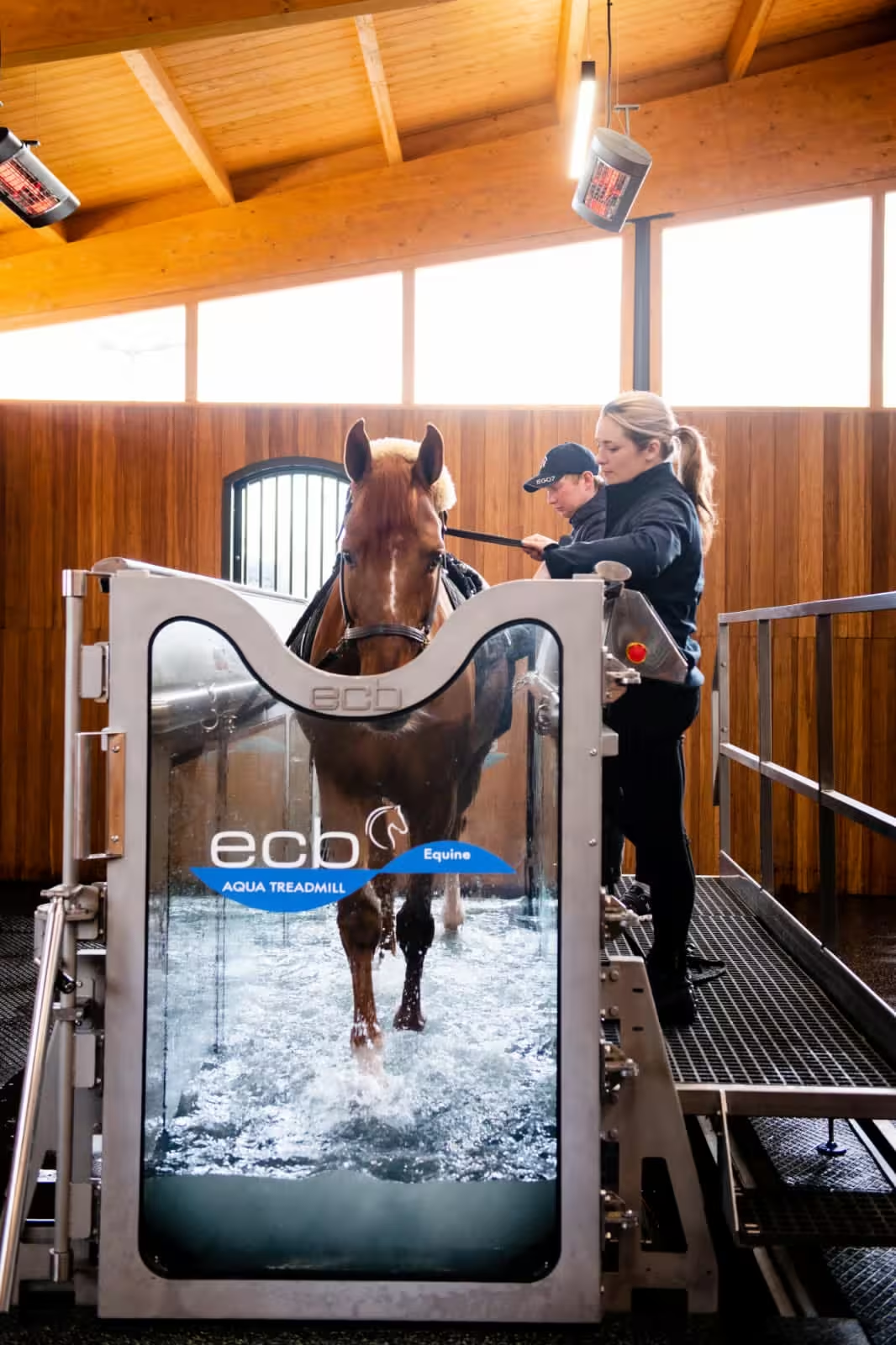
If you run a rehabilitation centre, a veterinary practice or a busy training yard, an equine underwater treadmill is probably on your shortlist. It is one of the few pieces of equipment that lets you control exactly how much work a horse does, how much load its limbs carry and how it moves, all in the same session. This guide explains how an underwater treadmill for horses works, what water depth and incline actually change, how much space and infrastructure you need, and what drives the purchase and running costs.
We have built equine hydrotherapy systems since the 1990s, with more than 500 installations in over 21 countries.
At its simplest, a horse underwater treadmill is a motorised belt inside a watertight chamber. The horse walks (or trots) on the belt while water is pumped in to a chosen depth. When the session ends, the water is pumped out to a holding tank, filtered and stored for the next horse.
The value comes from two opposing forces that the water creates:
Because these forces pull in different directions, the operator can shift the balance to suit the horse. A horse in early rehabilitation might need support with gentle work, while a fit competition horse might need maximum resistance with moderate support.
A modern aqua treadmill for horses lets you adjust several variables independently. On the ECB Equine Aqua Treadmill, the programmable touchscreen controls water level, speed, incline and session time simultaneously, and each horse can have its own stored program:
Large safety glass panels let the vet or therapist watch the limbs underwater and assess gait and stride as the horse works. You can read more about how our water treadmill for horses is designed for day-to-day use in a clinic or yard.
Water depth is the single most important setting on an equine underwater treadmill. It changes both the amount of support and the type of work, and different depths suit different stages of a program.
The key principle is simple: deeper water means more buoyancy and less limb loading, but more drag and resistance. Shallower water means less support and more normal loading. Neither is "better". The right depth depends on the injury, the stage of recovery and the goal of the session, and it should be agreed with your vet.
Good programs change one variable at a time and progress gradually. In our 12-week aqua treadmill training program, water depth is raised by 5 to 8 cm per session, and only while the horse keeps a regular four-beat walk. If the rhythm breaks down, the horse is telling you the step was too big, so you hold or return to the previous depth.
Fill time also matters in a busy clinic. The ECB rapid fill system reaches 60 cm in approximately 2.5 minutes, so the horse spends less time standing while the chamber fills and more time working.
Incline is the second major lever. On the ECB Equine Aqua Treadmill it runs from 0 to 12% in 1% steps, which allows very fine progression.
Walking uphill shifts more of the work onto the hindquarters. The horse has to push from behind, engage its core and lift through the back, which is why incline work is widely used to develop the topline and hind-end strength. Combined with water, buoyancy still protects the limbs.
As with depth, incline should be increased gradually. Adding incline and depth in the same session makes it harder to see which change the horse is struggling with.
The ECB Equine Aqua Treadmill runs on fresh or salt water, and an optional refrigeration package allows chilled water. Each option has a place:
If cold therapy is your main goal rather than exercise, a dedicated cold salt spa is a different tool. In an ECB spa, the horse stands in high-salinity water chilled to approximately 2°C (35°F) for 10 to 20 minutes, covering all four lower limbs. The two can complement each other in the same facility.
Installation is where many projects succeed or stall. An equine aqua treadmill is a heavy, plumbed, powered piece of equipment, so plan the space before you commit.
Full dimensions and options are listed in our aqua treadmill specifications. Belt dimensions are not published and are confirmed at quote stage.
We do not quote running cost figures here because they depend heavily on local energy and water prices, how many horses you treat and which options you choose. Instead, build your own estimate from these cost lines:
Practical features reduce labour: a droppings catcher and nappies are included, and easy-access sediment ports simplify cleaning. Remote diagnostics and video manuals help keep downtime low.
A used treadmill can look attractive, but the purchase price is only part of the cost. Before buying second-hand, check:
Our guide to buying used equine hydrotherapy equipment covers these checks in detail.
These three options are often compared, but they do different jobs.
The horse is weight-bearing, with load controlled by water depth. Gait, speed, incline and time are all adjustable and repeatable, and the glass panels let you watch the limbs. This makes it well suited to rehabilitation and structured conditioning.
Swimming is non-weight-bearing and provides strong cardiovascular work. However, the horse's back can hollow while swimming, and the session is less controllable. For a full comparison, see equine water treadmill vs swimming.
A dry high-speed treadmill is built for speed and fitness work. The GG high-speed treadmills we supply reach speeds of up to 45 km/h with a 6° incline, but the limbs carry full load. It complements rather than replaces a water treadmill. See our high-speed horse treadmill for details. Note that the ECB aqua treadmill can also be used dry for walking work.
ECB does not publish prices, because the final figure depends on the specification. The main price drivers are:
Our buyer's guide on how much an equine aqua treadmill costs walks through each driver and how to compare quotes fairly.
It depends on the machine and the session. The ECB Equine Aqua Treadmill adjusts up to 104 cm (41 in). Sessions typically work at fetlock, knee and hock, or forearm and stifle depth, with deeper water giving more buoyancy and more resistance.
Frequency should be set by your vet or therapist based on the horse's condition and goals. Whatever the schedule, progress gradually: our 12-week program raises depth by 5 to 8 cm per session only while the horse maintains a regular four-beat walk.
Yes. Aqua treadmill, water treadmill and underwater treadmill all describe the same equipment: a motorised belt inside a chamber that fills with water to a controlled depth while the horse walks or trots.
For the ECB built-in model, plan a bay of approximately 20 ft x 12 ft with 12 ft of clear headroom around a pit of 4,956 mm x 2,170 mm x 1,608 mm deep. The floor-mounted model measures 6,932 mm x 2,610 mm x 2,008 mm high and needs no excavation.
Yes, if the system is designed for it. The ECB Equine Aqua Treadmill runs on fresh or salt water, and an optional refrigeration package allows chilled water.
Choosing an equine underwater treadmill is a long-term decision that affects your building, your workflow and your results. If you would like to discuss your space, your caseload or the options for an ECB equine water treadmill, contact our team in the US or UK for a tailored specification and quote.