

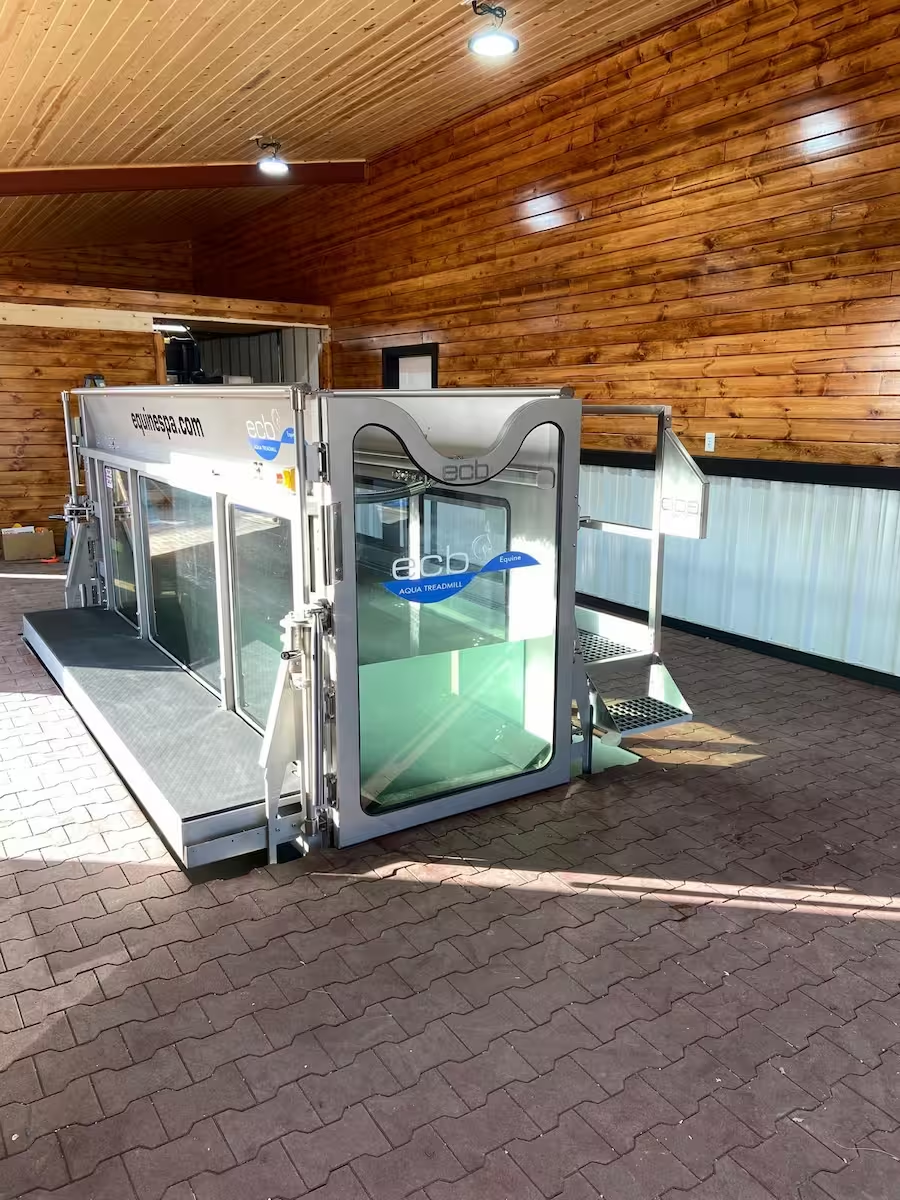
The second-hand market for equine hydrotherapy equipment is small, opaque and almost entirely un-inspected. Units change hands when a facility closes, downsizes or upgrades, and they are usually sold the way a horse is sold at the yard gate — on a photograph, a phone call and a degree of trust. Sometimes that works out well. Sometimes a buyer collects a spa that looked immaculate in a cold, dry, switched-off state and discovers three months later that the chiller cannot hold temperature on a warm afternoon.
This is a pre-purchase inspection guide. It is written by people who build this equipment new, which is worth stating plainly: we have an obvious interest in selling you a new machine. We have written it straight anyway, because a facility that buys a used unit badly is a facility that concludes hydrotherapy does not work, and that is worse for everyone. If a good second-hand unit at the right price is the correct decision for your operation, this should help you find one and avoid the ones that will cost you.
A cold saltwater spa is a chilling plant, a pumping circuit and a pressure vessel that holds a horse. Salt at roughly ten times seawater concentration is relentless on everything it touches, and the machine spends its life wet. Inspect in this order:
The chiller. This is the single most expensive component and the one most likely to be tired. It is also the easiest to hide, because a chiller that has lost capacity still gets cold — just not cold enough, not fast enough, and not on a hot day with a horse in the tank. Ask when it was last serviced and by whom, ask whether the compressor or condenser has ever been replaced, and insist on seeing it run. A chiller working hard on a mild day with an empty tank is telling you something.
Pumps and circulation. Listen for bearing noise and cavitation. Ask how many pumps the unit has, whether any have been replaced, and whether spares are stocked. Pumps are consumable and comparatively cheap; a seller who has replaced them on schedule is a seller who has maintained the machine.
Seals and door mechanism. The door is the part a horse interacts with most and the part a hurried groom mistreats. Check the seal along its whole length, look for daylight and for compression set in the rubber, and open and close it repeatedly. On a half-door design, check the latch, the hinges and the frame for distortion — a door that has been forced against a moving horse leaves evidence.
Salt corrosion. Look everywhere the seller has not painted. Fasteners, brackets, pipework unions, the underside of the frame, the plant compartment, anywhere water sits and evaporates. Surface bloom on stainless is cosmetic; pitting is not, and pitting around a structural fixing is a reason to walk away. Fresh paint on a machine of this type deserves a specific question about what is underneath it.
The tank shell and flooring. Check the GRP or shell material for crazing, stress cracks around fixing points and repairs. Check the floor the horse stands on for wear and for grip — a polished floor in a spa is a slip injury waiting to be attributed to your facility rather than to the previous owner.
A water treadmill combines everything above with a moving mechanical system operating in water. There is more to go wrong and more of it is expensive.
Belt and running surface. Inspect the full length under tension with the belt moving, not stationary. Look for edge fraying, delamination, uneven wear across the width — which usually indicates a tracking problem rather than a belt problem — and for hard or glazed patches. Ask what a replacement belt costs and what the lead time is before you look at anything else, because that number often reframes the whole purchase.
Drive and gearbox. Run it up through the speed range empty and listen at each step. Whining, knocking or a speed the unit will not hold steady are all reasons for a specialist inspection. Ask whether the drive has ever been submerged beyond its design, which happens more often than sellers volunteer.
Incline mechanism. Cycle it through the full range in both directions, several times, and watch for hesitation, noise, or a unit that will not return cleanly to level. Incline actuators live in a wet environment doing heavy work and they are not a trivial repair.
Tank seals and glazing. A water treadmill has to seal a moving belt against a tank that fills and drains many times a day. Inspect every seal, and fill the tank to working depth and leave it — a slow leak shows itself in twenty minutes, not in two. Check glass panels for chips, crazing and, critically, the condition of their seals and retention.
Water handling. Time a full fill and a full drain. Slow drainage between horses destroys throughput, which destroys the economics of the machine. Inspect filtration housings, check whether filter elements are still available for that model, and ask about the chilling circuit as you would for a spa.
Controls. Power up the control system and work through every function, including the stored programmes. A dead or obsolete controller on an older unit can be genuinely unfixable if the manufacturer no longer supports the board.
A localised cryotherapy system is simpler, lighter and easier to inspect — and correspondingly easier to sell in a condition the photographs do not reveal.
The delivery system. Hoses, connectors and the applicator itself endure repeated extreme thermal cycling. Inspect hoses along their full length for stiffness, cracking and perished sections at the connector ends. Check the applicator nozzle for damage and for blockage.
Seals and valves. A CO₂ system that leaks does not fail dramatically; it just consumes gas and under-delivers. Ask to see the unit connected to a live cylinder and run a full treatment cycle. A seller unwilling to demonstrate that has told you something.
Control and calibration. If the unit meters delivery or has thermal imaging, check that the readings are plausible and that the device has been calibrated. An uncalibrated instrument delivering an unknown dose to a horse's leg is not a therapeutic device.
Cylinder compatibility. Confirm which cylinder fitting and which gas specification the unit requires, and confirm you can source that gas locally. Food-grade CO₂ in the correct siphon configuration is not the same as whatever the local welding supplier stocks.
Almost every bad used purchase in this sector shares one feature. The buyer inspected the machine cold, dry and switched off.
Insist on the opposite. Arrange the viewing so the unit has been running for at least an hour before you arrive and is still running when you get there. Then:
Measure, do not accept. Take your own thermometer. Take the temperature of the water yourself, at the start of a session and again after twenty minutes of the plant working. A spa that will not hold its target temperature under load has a chiller problem regardless of what the panel display says.
Watch a real session if you possibly can. A horse in the machine is the only honest test. Doors behave differently with a live animal against them; belts track differently under weight; pumps sound different when the tank is loaded.
Photograph everything, including the plant room. Not for the seller — for the technician you will ring afterwards for a second opinion. Photograph model and serial plates on every major component, including the chiller and the drive, because those plates are how you will establish what spares exist.
Read the service history, or note its absence. Ask for dated records, invoices and the name of the engineer who has maintained it. "It has never given us any trouble" is not a service history. On a machine of this value, no records should move the price materially or end the conversation.
Ask why it is being sold. An upgrade or a closure is a good answer. Vagueness is not.
Some faults are simply the end of a machine's commercial life, and recognising them on the day saves an expensive education:
Structural corrosion. Pitting or section loss in a load-bearing frame member or around a structural fixing. This is not a repair; it is a rebuild, and it is a safety matter with a horse and a handler standing on it.
Cracked or repaired tank shells. A shell that has been patched has usually been patched because it moved, and it will move again.
Obsolete control systems. If the manufacturer no longer supplies the control board and no third party supports it, one failure retires the machine. Establish support status before you establish price.
Chillers no longer supported on refrigerant. Refrigerant regulation changes, and a plant running a phased-out gas can become uneconomic to recharge regardless of its mechanical condition. Check the refrigerant type against current rules in your jurisdiction.
Anything with no parts route at all. Which brings us to the question that should be asked first and almost never is.
Most buyers work down from the machine to the paperwork. Reverse it. Before you inspect a single seal, establish three things:
Does the manufacturer still exist, and does it still support this model? Get the model and serial number from the seller before you travel and ask the manufacturer directly. Reputable manufacturers will tell you. It costs you a phone call and can save you a wasted day and a bad purchase.
Are consumables and wear parts available, at what price and what lead time? Belts, seals, filter elements, pump assemblies, applicator components. A machine you cannot get a belt for in under three months is a machine that will sit idle through your busiest quarter.
Does any warranty or support transfer, and is the unit in a supported territory? Manufacturer warranties are frequently non-transferable, and support territories are real — a unit bought cheaply in another country may be outside the network that services it. Buying across a border is where the largest number of used-equipment disappointments originate.
Note too that unauthorised modification or self-repair generally ends any residual support. If the seller has fitted a non-original pump or rewired a control panel, price the machine as unsupported.
The machine is often the cheaper half of the project. Buyers of new equipment get a site survey; buyers of used equipment frequently do not, and discover the site requirements after the unit is on the lorry.
Power. Chilling plant and drives are substantial electrical loads, often three-phase. Confirm the supply requirement in writing and confirm your building has it. Bringing three-phase to a barn can cost more than the machine.
Water supply and drainage. Fill rate determines throughput. Drainage determines whether you can turn the tank around between cases, and it has to go somewhere legally — saltwater discharge is regulated in many jurisdictions and cannot simply be run onto a field or into a surface drain.
Floor loading. A full tank plus plant plus a horse is a serious point load. An older barn floor may need engineering assessment and possibly a new slab.
Access. Measure the route in, not just the room. Door widths, roof height, turning circles, and whether the ground will take the delivery vehicle and the lifting equipment. Units have been bought that physically could not be got into the building they were bought for.
Commissioning. Someone has to decommission it at the seller's site, transport it, reinstall it and commission it. Establish who, at what cost, and whether they will stand behind the result — before you agree a price, because these costs are routinely a meaningful fraction of the purchase.
Our equipment checklist for setting up a rehabilitation centre covers site requirements in more detail, and the spa maintenance and operations guide sets out the servicing regime any unit you buy will need from day one.
This is the calculation worth doing properly, and it is arithmetic rather than argument. Build both columns over a five-year horizon:
For the used unit: purchase price, decommissioning, transport, installation and commissioning, any immediate remedial work found at inspection, the wear parts you know are due within five years, and — the item everyone omits — the expected value of unplanned downtime. Downtime is the real cost of used equipment. A rehabilitation centre with a machine out of service for six weeks is not merely inconvenienced; it is turning away cases and referring them to a competitor who may keep them.
For the new unit: purchase price, installation, warranty cover through the period, training included at handover, and a downtime expectation close to zero for the first several years.
Then divide each total by the number of sessions you realistically expect to run. Cost per session is the honest comparator, and it is where used equipment frequently loses despite winning on the sticker. A used machine at a large discount that is unavailable for two months a year, needs a belt and a chiller service in year two, and carries no support has a cost per session that can exceed the new equivalent.
Where used genuinely wins: a recent unit from a supported model line, with full service history, from a closing facility rather than a trading dealer, in your own country, with a parts route confirmed by the manufacturer, inspected hot and under load. That machine exists, it comes up a few times a year, and it can be an excellent purchase.
Where used reliably loses: an unsupported model, no records, bought remotely on photographs, inspected cold, with installation costs discovered afterwards.
Inspect it hot and running, never cold and switched off. The priorities are the chiller — the most expensive component and the one most likely to have quietly lost capacity — followed by pumps, door seals and mechanism, salt corrosion around structural fixings, and the condition of the tank shell and floor. Take your own thermometer and verify the unit holds target temperature after twenty minutes under load rather than trusting the panel display. Then ask for a dated service history; its absence should move the price or end the conversation.
Sometimes, and it must be established before you buy rather than after. Take the model and serial number from the seller and ask the manufacturer directly whether the model is still supported, what wear parts are available, at what price and what lead time, and whether your location falls inside a supported service territory. Manufacturer warranties are usually non-transferable, and unauthorised modification or self-repair generally ends any residual support. A belt with a three-month lead time is a machine idle through your busiest quarter.
Service life is determined far more by maintenance regime and water chemistry discipline than by age on the plate. A well-maintained system with a documented servicing history, correct salt management and scheduled replacement of pumps, seals and belts stays in commercial service for many years. A neglected one degrades quickly, and salt corrosion in particular is progressive and unforgiving. When assessing a used unit, weight the service records more heavily than the year of manufacture — a documented ten-year-old machine is very often the better buy over a five-year-old one with no history.
Not always, and the way to find out is to compute cost per session rather than compare purchase prices. For the used unit include decommissioning, transport, installation, commissioning, remedial work found at inspection, wear parts due within the period, and the revenue cost of unplanned downtime. For the new unit include installation, warranty cover, training at handover and a near-zero downtime expectation. Used wins clearly for a recent, supported, fully documented machine bought locally. It frequently loses for an unsupported unit bought remotely, because downtime and parts lead times overwhelm the discount.
Four things decide whether an installation is straightforward or expensive: electrical supply, often three-phase for chilling plant and drives; water supply with sufficient fill rate, plus legal drainage — saltwater discharge is regulated in many jurisdictions and cannot simply be run to a field drain; floor loading capable of carrying a full tank, plant and a horse, which may need engineering assessment in an older barn; and physical access, meaning door widths, roof height, turning circles and ground bearing for the delivery and lifting equipment. Buyers of new equipment get a site survey covering all four. Buyers of used equipment usually have to commission one themselves, and should.
If you are weighing a used unit against new, the most useful thing we can do is answer the support question honestly for the specific machine in front of you. Send us the model and serial number and we will tell you whether it is a supported ECB unit, what parts are available for it, and what a commissioning visit would involve — whether or not you end up buying from us.
If you are still deciding what the facility actually needs, start with the full product range, or look at the individual systems: the cold saltwater equine spa, the water treadmill, and INSTANTCRYO for localised cryotherapy. The spa locator shows facilities running ECB systems, several of whom are happy to let a prospective buyer see a machine in daily use.
To talk it through, use our contact page — or call +1 973-383-5511 (Americas) or +44 (0)1451 822969 (UK and rest of world).