

Opening an equine rehabilitation center is a construction project, a clinical project, and a marketing project all running at the same time. Most teams under-plan the construction project, over-plan the clinical project, and forget about the marketing project until two weeks before the doors open. This checklist is structured to keep the three in balance.
We are not going to invent capital figures we cannot source — there is no single industry CAPEX number that survives the geography test. What we will give you is a complete equipment checklist with the dimensional, mechanical, and operational specs that determine whether your build works on day one. If you are planning this in 2026, this is the conversation to have before you pour a slab.
A working equine rehabilitation center is a small constellation of treatment bays, surrounded by support spaces. The treatment bays generate revenue. The support spaces enable throughput. Get the throughput right and the revenue follows.
There are five questions that drive the whole project:
Most projects under-spend on question one (and over-build a salt-spa room that sits idle) or under-spend on question three (and open with no inbound caseload). The equipment list below assumes you have honest answers to those five questions on hand.
The four pieces of treatment equipment that anchor most working equine rehabilitation centers are an aqua treadmill, a saltwater spa, a cryotherapy system, and a high-speed treadmill for conditioning work. You do not need all four on day one. You do need a clear sequence for adding them.
1. Aqua treadmill — first in, every time.
The aqua treadmill is the single highest-revenue piece of equipment in a rehab center. Brenda Mcduffee at The Sanctuary in Ocala described it as "the most profitable, most widely used piece of equipment in the facility." Bruce Jackson at Fair Hill said the same. Travis Hunter at Equine Rehabilitation and Conditioning said the spa "funded the expansion of our facility."
Operationally, the aqua treadmill supports both rehab caseload (referred by vets) and prevention caseload (regular sessions for performance horses), so the calendar fills from two directions. A 20-minute session cycle means a single bay handles three to four horses per hour at sustained pace, with documented peak days at 20+ sessions.
Site spec: an enclosed bay approximately 20 feet long by 12 feet wide, 12 feet of clear ceiling height, a structural slab with a sized pit (ECB's pit footprint is 4,956 mm by 2,170 mm by 1,608 mm), a dedicated 220V circuit, pressurised cold water with a softener on hard mains, and floor drainage connected to a sized sump or surface drain.
2. Saltwater spa — second in.
The cold saltwater spa is the rehab workhorse for lower-limb soft-tissue injuries. It complements the aqua treadmill rather than competing with it: the treadmill is loading, the spa is unloading. Operators commonly run the same horses through both bays in sequence.
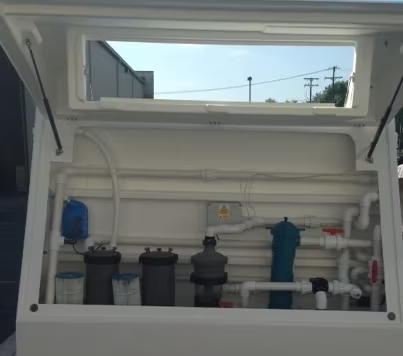
Site spec is similar to the aqua treadmill bay — a dedicated 220V circuit, drainage, water supply — with the addition of a chiller capable of holding water at 2°C and storage for salt at scale. ECB ships a chiller and a starter salt supply as part of the system.
A documented operational benchmark: the ECB Equine Spa supports up to 3,000 treatments per 2,000-litre water charge, which is months of operating capacity per change at any realistic day rate.
3. Cryotherapy — third in.
INSTANTCRYO is the targeted-cold modality of choice for hot-spot treatment of inflammation, joint issues, and post-exercise recovery, with -78°C CO₂ delivery, HD thermal imaging for placement, and specialised nozzles for different regions of the limb. It pairs with the aqua treadmill for sequenced sessions (treadmill loading, cryo for hot spots) and with the saltwater spa for clients who do not want the systemic cold of a full-spa session.
Site spec is the lightest of the four: a treatment room with reasonable ventilation, a CO₂ cylinder bay nearby, and standard electrical. No pit, no chiller, no drainage. Most operators add cryotherapy at month 9 to 18 once the calendar around the wet-room treatments is filling reliably.
4. High-speed treadmill — last in, or first if you are a training facility.
The GG Engineering high-speed treadmill is a conditioning and gait-analysis tool, not a rehab tool in the soft-tissue sense. It belongs in a center that also serves performance stables, training yards, or veterinary clinics doing dynamic gait work. Speeds up to 45 km/h and a 6° incline cover the conditioning, fitness, and dynamic-scope use cases that pure rehab equipment cannot.
Site spec: a room with 12 feet of ceiling and enough side clearance for the operator and a tracking vet, an extraction fan for ventilation, and a dedicated electrical run. The cushioned low-impact bed shifts the conversation from rehab to performance, which is why some operators run it in a separate room from the wet bays.
The treatment bays are the headline. The support equipment is what makes the treatment bays useful.
Stainless-steel stable equipment. Stalls, partitions, doors, feeders, gates, and the stocks horses stand in for veterinary work. Stainless-steel construction earns its premium in a rehab environment because the throughput is high, the cleaning regime is aggressive, and the depreciation curve on coated steel and aluminium is steeper than it looks on the brochure. Buy once, well.
Weighing platform. A horse weigh scale is not optional for a rehab center that takes its caseload seriously. Body weight tracking across a rehab block is a clinical primary-source data point and a marketing one: you can show the owner the trajectory. Plan a weighing bay near the intake stall row.
Treatment-room fixtures. Wash bay with hot water, drying area, treatment stalls, a clean and a dirty room for veterinary supplies, secure storage for medications, and a clinical-grade trim and shoeing area if your model includes farriery.
Intake and recovery stalls. A working rehab center needs stalls for short-stay clients (overnight to a week) and longer-stay clients (full rehab blocks of four to eight weeks). The ratio is geography-dependent — facilities near a thoroughbred corridor see more short-stay; facilities in a destination model see more long-stay.
Get these wrong and the rest of the build is a recovery effort.
Slab. Reinforced concrete, load-rated for the wettest combination — flooded aqua treadmill bay with a horse on the treadmill plus the operator and a vet. Have a structural engineer sign off the pour, not a general contractor. Pour conduit before you pour concrete.
Drainage. Floor drains inside every wet bay, connected to a sized sump or to a surface discharge that meets local effluent code. If you are recovering water for reuse, plan the filtration loop before you commission the slab.
Electrical. Dedicated 220V single-phase or 3-phase (region-dependent), sized to the chiller, the drive systems, and the pumps with margin for a second bay. Future-proof the panel — adding capacity is cheap during the build and expensive after.
Water. Pressurised cold water within reach of every wet bay. A softener on hard mains water. Hot water at the wash bay and the treatment stalls. Storage for at least one full water-change worth of salt and chemistry within the building footprint.
Ventilation. Equine rehab building design guidance (EquiManagement is a useful reference) calls for four to six air changes per hour in dry rooms and more in wet rooms. The cryotherapy room needs extraction sized to the CO₂ delivery rate. The high-speed treadmill room needs serious extraction or you will lose horses to heat stress in summer.
Lighting. Natural light wherever you can get it. Clerestory glazing or frosted skylights work well in metal building shells. Supplement with high-CRI artificial lighting at the treatment bays so the vet can read leg conformation honestly.
The equipment list does not matter without the people. A small-to-medium working equine rehabilitation center typically runs a model along these lines:
The staffing ratio matters more than the equipment list in year one. A bay sitting empty because there is nobody to run it is a worse outcome than a bay that does not exist yet.
Specific staff-per-bay ratios are operating-model dependent — get the model right by talking to two or three reference facilities in your region before you set headcount.
There is a lot of noise in the equine rehab credential space. The credentials that are real, recognised, and worth budgeting for staff to obtain:
Do not budget for credentials whose certifying body you cannot find a website for. If a credential's organisation does not have a current public presence, it is not a credential.
Most working centers we cite in this piece — Fair Hill, The Sanctuary, Selway, Equine Rehabilitation and Conditioning — opened with one or two bays and added the rest as revenue arrived. That is the model we recommend by default.
Phase one (day one): aqua treadmill bay, intake stalls, wash bay, drainage, electrical, water, ventilation, slab to spec for all future bays.
Phase two (months 4 to 9): saltwater spa bay, additional treatment stalls, expanded recovery stall capacity, stocks for veterinary work.
Phase three (months 9 to 18): cryotherapy bay, weigh scale, expanded clinical space.
Phase four (year 2): high-speed treadmill, advanced diagnostics integration, expanded staff.
Phasing typically reduces day-one capital expenditure by 25 to 40 percent versus a full-build approach, and lets revenue from phase one fund phase two. The cost is a longer build timeline; the benefit is that you do not finance equipment that is not earning yet.
A note for buyers planning a full build: pour the slab for every phase on day one even if you are only commissioning the phase-one bays. Coming back to break and re-pour later is the most expensive way to do this.
Specific dollar or pound CAPEX numbers across all geographies. They mislead more than they help.
Specific staffing ratios across all facility sizes. They are operating-model dependent.
Specific session pricing across all markets. We have given you the published reference points (Sterling Equine, Shardeloes Farm, Champion Fit Equine); your local market is the one that matters.
The four-piece core equipment loadout is an aqua treadmill, a saltwater spa, a cryotherapy system (INSTANTCRYO), and a high-speed treadmill for performance/conditioning work — with the aqua treadmill in phase one, the spa in phase two, cryotherapy in phase three, and the high-speed treadmill last (or first, if performance work is your primary market). Support equipment includes stainless-steel stable equipment, a horse weigh scale, a wash bay, treatment stalls, and intake/recovery stalls. Utilities to plan from day one are a reinforced concrete slab, sized drainage, dedicated 220V electrical, pressurised water with a softener, ventilation at four to six air changes per hour in dry rooms (more in wet rooms), and high-CRI lighting at the treatment bays.
Yes — most working facilities we cite did. Phase one is the aqua treadmill bay plus intake stalls, wash bay, and full utility infrastructure. Phase two is the saltwater spa. Phase three is cryotherapy. Phase four is the high-speed treadmill. Phasing reduces day-one CAPEX by 25 to 40 percent and lets phase-one revenue fund the later phases.
Either on staff or contracted. The clinical caseload needs a veterinary signoff on rehabilitation protocols, and the referral relationship works better when the referring vet has a peer on the receiving end. The veterinary partner is also the most important part of the marketing model — the referral pathway is the demand pipeline.
CERP (University of Tennessee CVM) is the senior credential for vets and lead technicians. CERA (Animal Rehab Institute) is the path for veterinary technicians and equine science graduates. NBCAAM and IAAT (UK) cover related therapy specialisations.
Under-pouring the slab and under-sizing the electrical panel. Both are cheap to do correctly on day one and expensive to correct after the building is up. Pour the slab and run conduit for every future bay before you commission phase one.
If you are planning a facility, the next useful conversation is a configured quote with site-prep ranges and a phased build path for your address. Contact ECB Equine through the Contact Us page, and review the Aqua Treadmill, Equine Spa, INSTANTCRYO, GG High-Speed Treadmill, and Stainless Steel Stable Equipment product pages for the full equipment specification, plus the Rehabilitation Centers solution page for facility planning context.