

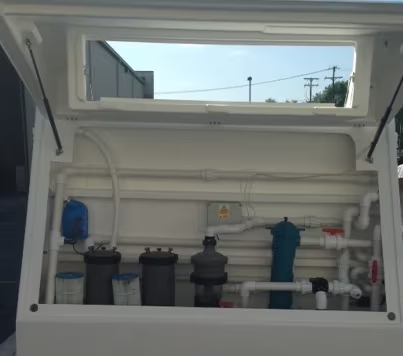
An equine spa is a precision piece of equipment running an unusual fluid — extreme cold, extreme salinity, biological load from the horse, and the wear that comes with thousands of sessions per year. The facilities that get twenty years of reliable service out of an ECB Equine Spa are the ones that treat maintenance as a discipline, not an afterthought. The facilities that struggle are almost always running an excellent spa on a casual maintenance routine.
This guide is the operating manual we wish every spa owner had pinned to the wall of the pump room. It covers salt management, water quality, daily checks, the weekly clean-down, monthly servicing, annual overhaul, troubleshooting, and the most common operational mistakes that cost facilities money and downtime. It is written for the people who actually run the spa — yard managers, head grooms, facility operators, and the lead technician at multi-spa rehabilitation centers.
An ECB Equine Spa is not a swimming pool. It runs at roughly ten times seawater salinity, at a target temperature of approximately 2°C (35°F), with a closed-circuit filtration system designed for the specific chemistry of cold concentrated brine. The maintenance practices that work for a leisure pool will damage a spa — chlorination is unnecessary and chemically inappropriate, balancing additives will throw off the salinity, and conventional filter media will not last in this environment.
The right approach is simple but disciplined: maintain salinity in the target range, manage biological load through filtration and routine clean-downs, keep the chiller and pump systems serviced on schedule, and respond to any change in performance immediately rather than letting it compound.
Every spa should be checked before the first horse of the day. The checks take five minutes once they are routine and they catch every small problem before it becomes a session-cancelling event.
If anything is out of range, fix it before running a session. A horse in a spa that has drifted out of specification is not getting the therapeutic benefit you are charging for, and in extreme cases is being exposed to conditions that are not safe.
Salinity is the most important variable in spa operation. The salt does therapeutic work, raises the buoyancy, and lowers the freezing point of the water so the chiller can hold target temperature reliably. If the salinity drifts, everything drifts with it.
Target range. The ECB Equine Spa target is roughly ten times the salinity of seawater. Refer to your installation specification for the exact target — there is small variation by region and water chemistry. Stay within the upper and lower bounds at all times.
Why salinity drops. The horse leaves the spa wet. The salt going out of the spa with the horse is real, especially with high session volume — a busy yard running 30 sessions per day is losing measurable salt every day. Top up routinely, ideally daily, never weekly.
Why salinity rises. Evaporation. The water leaves the spa as water vapor; the salt does not. In hot climates or in covered facilities with high ambient temperature, salinity creeps up. Top up with fresh water to bring the reading back to target.
Salt type and grade. Use the salt specification supplied with your ECB Spa documentation. Substituting with non-specified grade salt — including some agricultural and food-grade products — can introduce trace contaminants that damage the chiller and filtration components over time.
The measurement discipline. Measure salinity once daily at minimum. Log every reading. Trends are more informative than single readings, and an electronic log makes it easy to catch a slow drift before it crosses out of specification.
The horse adds biological load to the spa — sweat, skin oils, surface contaminants from the limb. The closed-circuit filtration system handles most of this in real time, but routine intervention is required.
Filter maintenance. Follow the maintenance schedule for your specific filter cartridge or sand bed. Clean and backwash on the recommended interval — typically weekly for high-volume operations, every two weeks for medium-volume facilities. Replace cartridge media on the recommended replacement cycle, which is usually six to twelve months depending on volume.
Skimmer cleaning. Daily. The skimmer basket fills with particulates from the horses' limbs and shoe debris. An overflowing skimmer basket passes contamination into the filter system and shortens filter media life.
Weekly clean-down. Once a week, every week, run the full clean-down procedure: drain to the lower-service level, wipe down the spa walls with the approved cleaning product, inspect the surfaces and joints for any damage, refill, and re-establish salinity. The full clean-down protects the spa from biofilm buildup and lets you spot any developing surface or seam issue before it becomes structural.
No chemicals beyond specification. Do not add chlorine, bromine, pool clarifiers, algicides, or any product designed for fresh-water leisure pools. The high salinity environment does not support algae growth, the cold prevents most bacterial proliferation, and the filtration system is specified for the chemistry as designed. Adding off-specification chemicals will damage components and void warranty.
The chiller is the heart of the spa and the component most likely to fail prematurely if it is not maintained. The good news is that ECB chillers are specified for continuous duty in this environment — what they need is routine attention, not heavy intervention.
Condenser coil cleaning. The condenser coil is the heat-exchange surface on the warm side of the chiller. It will accumulate dust, hay debris, and (if installed outdoors) general weather grime. Clean monthly with the approved coil cleaning product. A dirty condenser coil makes the chiller work harder, raises operating cost, shortens compressor life, and in hot weather will cause the chiller to lose target.
Refrigerant pressure check. Quarterly, by a qualified refrigeration engineer. Low refrigerant is a leak signal — find it and fix it. Topping up without finding the leak is a temporary measure that turns into a major repair.
Compressor inspection. Listen during normal operation. Unusual sounds, vibration, or temperature signatures should trigger a service call. Compressor replacement is the largest single cost of chiller ownership and is almost always preventable with routine maintenance.
Annual chiller service. A full annual chiller service performed by a qualified engineer extends operational life by years. The service typically includes refrigerant inspection and top-up if required, condenser and evaporator coil clean, electrical inspection, control board verification, and replacement of any wear components approaching end-of-life.
The maintenance discipline that works is a written, time-based schedule. Everyone knows what gets done when, the operator who does it is named, and the work is logged.
Daily (every operating day): water temperature, water level, salinity, visual water inspection, pump pressure, chiller sight check, skimmer basket clean, session log.
Weekly: filter clean or backwash, full clean-down procedure, visual structural inspection of all surfaces and seals, refill and salinity re-establishment, calibration check on the hydrometer or refractometer.
Monthly: condenser coil clean, comprehensive pump inspection, comprehensive electrical inspection of accessible components, log review for trend analysis, full water quality assessment.
Quarterly: refrigerant pressure check by qualified engineer, filter media replacement assessment, pump impeller inspection, control system review.
Annually: full chiller service, structural inspection including any below-grade or below-floor components where applicable, pump rebuild or replacement if indicated by performance trend, control board firmware update if available, full warranty and service contract review.
Most spa operating problems fall into one of five categories. Knowing the diagnosis pattern lets you fix small issues fast and escalate the right ones.
Spa temperature rising. Most common cause: dirty condenser coil. Second: low refrigerant. Third: ambient temperature exceeding chiller specification on a hot day with insufficient ventilation. Fourth: chiller fault requiring engineer attention.
Water becoming cloudy. Most common cause: filter overdue for clean. Second: filter media end-of-life. Third: high biological load from a session day spent above operating volume. Fourth: incorrect salinity (low) allowing some biological activity.
Pump pressure rising. Filter is loading up. Clean or backwash. If pressure remains high after a thorough filter service, check for partial blockage in the intake or return lines.
Pump pressure dropping. Possible air ingress (check seals and inlet), possible pump impeller wear (inspect), possible developing leak in the return line. Investigate immediately — pressure drop is a fast-developing issue.
Salinity drift. Top up appropriately (salt or fresh water) to bring back to specification. If salinity is drifting faster than your session volume explains, check for a leak — the salt is going somewhere if it is not going with the horses.
Three operational habits separate well-run spa programs from costly ones.
Skipping daily checks because "nothing's wrong." Daily checks catch problems before they become incidents. The five-minute morning routine prevents thousand-pound repair bills and lost session days.
Topping up salinity by guess. Salt is added based on a measured reading, not a sense of "it feels right." A facility running on guess-based salinity management always drifts — sometimes high, sometimes low — and the chiller and filter both suffer.
Putting off the chiller service. Chiller engineers are expensive. Annual service is more expensive than skipping a year. Skipping the annual service for three years and then replacing a failed compressor is dramatically more expensive than either. The cheapest chiller maintenance you can run is the manufacturer-specified schedule.
Long-running spa facilities all have the same operational pattern: written procedures, named accountable operators, electronic logs, and a relationship with a qualified refrigeration engineer for the chiller. The investment in setting up the discipline is small. The payoff is twenty years of reliable service from a spa that was specified to deliver exactly that.
For facilities running multiple spas, the discipline scales — a shift handover sheet, a centralized maintenance log, and a designated lead operator are the basic structure. Rehabilitation centers running spa programs across multiple stables typically also schedule a quarterly cross-facility audit to ensure operating standards do not drift between locations.
The structural body of the spa is engineered for decades of service — installations running for fifteen and twenty years are routine. The chiller and pump systems are the wear components, and with the maintenance schedule above, they comfortably reach manufacturer-specified end of life. One of our oldest installations, at Emma Hawthorne's facility at Flawborough, has been running since 2001.
Use the salinity target on your installation specification — there is small variation by configuration. Measure with a calibrated refractometer (most accurate) or a calibrated hydrometer. Calibrate the instrument against a known reference solution at least quarterly.
In most regions, yes — but check your local water quality. Hard water with high mineral content may require pre-treatment. Water with high chlorine or chloramine concentrations is fine for refilling because the chemistry will rebalance, but should be allowed to off-gas briefly before topping up.
Operating cost depends on chiller efficiency, ambient temperature, facility insulation, and session volume. Most well-installed ECB Spas in temperate climates run between three and six kilowatt-hours per session day equivalent on the chiller. The pump runs continuously at low draw.
Step one: check the condenser coil — if it is dirty, clean it and re-evaluate. Step two: check the pump pressure — if the filter is overloaded the flow through the chiller drops and the system cannot remove heat efficiently. Step three: if both are normal, call your refrigeration engineer. Do not run sessions on a spa that is out of temperature specification.
A full drain and refill is typically scheduled once or twice a year, depending on operating volume, water quality, and the recommendation from your service technician. The weekly clean-down handles most of the routine cleaning need; the full drain is a deeper refresh.
Warranty terms are specified in your installation contract. The single most common warranty issue is operator-driven — running the spa outside specification (wrong salt grade, off-specification chemical additives, missed services). Follow the schedule above, log everything, and the warranty conditions remain met.
The ECB team supports every installation with documentation, training, and ongoing technical support. The maintenance schedule above is a working framework, but it does not replace your specific installation manual or the guidance from your service engineer.
If you are a current ECB Spa operator and have questions about your specific installation, your service contract, or a developing operating issue, contact the team directly. If you are evaluating an ECB Spa for a new facility and want to understand the operational profile before committing, the team can connect you with operating facilities of comparable scale who can share their own experience.
Explore the ECB Equine Spa page for full specifications, or read how an equine spa works clinically for the therapeutic side of the picture. To talk to the team about a maintenance question or facility consultation, contact us through the contact page — or call +1 973-383-5511 (Americas) or +44 (0)1451 822969 (UK and rest of world).