

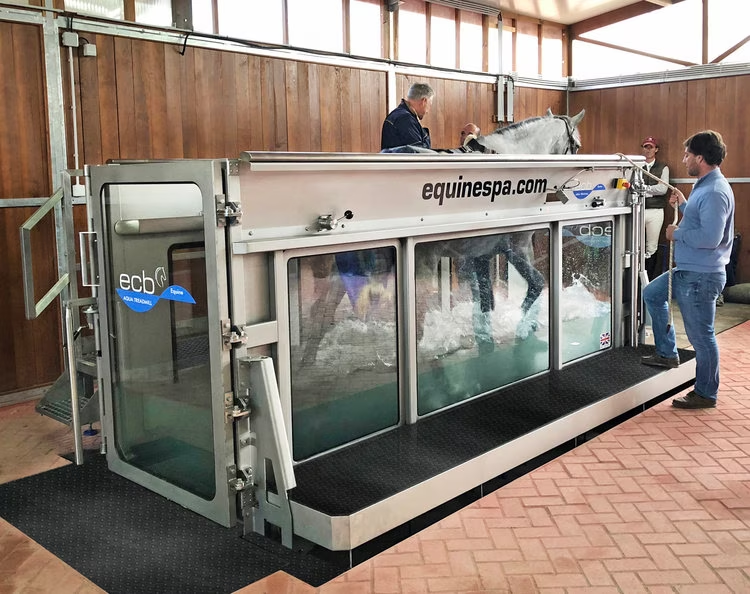
Ask a rehabilitation vet whether a horse should be on a water treadmill or in a swimming pool and the honest answer is that the question is slightly wrong. These are not two settings on the same dial. They load the horse in opposite directions — one adds controlled load to a limb that is learning to bear it again, the other removes load almost entirely. Choosing between them is not a preference. It is a clinical decision, and getting it wrong sets a rehabilitation back by weeks.
This guide is written for the people making that capital decision: rehabilitation centre owners, veterinary clinicians specifying equipment, and racing and performance yard managers deciding what goes into the build. It covers the biomechanics, the injuries each modality suits, the running costs, and the cases where neither is the right answer.
On a water treadmill, the horse walks. Its feet strike a moving belt, its limbs take load, and the water — filled to a chosen depth around the limbs — adds buoyancy, resistance and hydrostatic pressure to a gait the horse already knows. The animal is still weight-bearing. It is simply weight-bearing in a modified environment where you control how much load, how much resistance, and how much range of motion.
In a swimming pool, the horse's feet never touch anything. Load on the distal limb effectively disappears. The horse propels itself with a paddling action that resembles no gait it uses on land, driven hard by the respiratory and cardiovascular demand of keeping its nose above water. It is exercise, and it is intense exercise, but it is not locomotion in any form the horse's musculoskeletal system recognises.
That distinction is the whole argument. Tendon and ligament tissue remodels in response to load. The collagen fibres that repair a strained superficial digital flexor tendon align themselves along the lines of force applied to them; without force, they heal disorganised, and disorganised scar tissue is what re-injures. A horse that swims through its tendon rehabilitation arrives back in work with a cardiovascularly fit body and a tendon that has been given no reason to organise itself properly.
A water treadmill, by contrast, is a load-dosing instrument. You can put a horse in fetlock-deep water and give it a near-normal loading pattern with mild resistance. You can raise the water to the carpus and hock and get significantly increased joint flexion with meaningful unloading. You can go deeper still and take most of the weight off. Same machine, same horse, three genuinely different prescriptions — and you can move between them week by week as the tissue tolerates more.
Water depth is the single most useful variable in equine hydrotherapy, and it is the variable swimming does not have. As depth increases, three things change together:
Buoyancy rises and load falls. Every centimetre of submersion transfers more of the horse's mass to the water. This is what makes the treadmill usable early in a rehabilitation, before the limb can take full weight.
Joint flexion increases. This is the counter-intuitive one. Horses moving through deeper water lift their limbs higher and flex the carpus, fetlock and tarsus through a greater range than they do on dry land. Deeper water is not simply "easier" — it demands more range of motion while asking for less weight-bearing. For a horse recovering joint mobility after a long period of box rest, that combination is difficult to reproduce any other way.
Stride slows and lengthens. Resistance increases stride duration and reduces stride frequency. The horse spends longer in each phase of the stride, which is why water treadmill work is so effective at recruiting the deep postural musculature that a fast, short stride on land skips over.
There is an upper limit. Push the water past roughly the level of the elbow and stifle and the horse begins to float — at which point you have stopped running a treadmill session and started running a swim, with none of the control and all of the risk. Competent operators work below that line deliberately.
The ECB equine water treadmill is built around that control: variable water depth, up to 12% incline for additional hindquarter recruitment, chilled or ambient water in fresh or salt configuration, and a 100-program touchscreen so a prescribed protocol is repeated identically by whoever is on shift rather than reinvented each morning. Full glass side panels let the clinician watch limb placement through the stride, which matters more than any number on a screen.
Suited to a water treadmill. Superficial and deep digital flexor tendon injuries in the controlled-loading phase. Suspensory ligament desmitis, particularly proximal. Post-surgical return to work where progressive load is the goal. Loss of topline and epaxial muscle after box rest. Asymmetry and crookedness — the belt enforces a straight line the horse cannot evade. Osteoarthritic joints needing range of motion without concussion. General conditioning where you want cardiovascular work without the impact cost of another mile on hard ground.
Suited to swimming. Genuine non-weight-bearing periods — a healing fracture, a severe laminitic episode, a post-operative window where the surgeon has said no load on that limb. Cardiovascular fitness maintenance in a horse that physically cannot be worked on the ground. Horses with distal limb wounds or casts that must stay out of a treadmill tank. These are real indications, and where they apply a pool does something nothing else can.
Suited to neither. Back pain, kissing spines, and sacroiliac dysfunction deserve particular caution around swimming. Swimming horses typically extend the neck and hollow through the thoracolumbar spine — precisely the posture most back cases need to avoid. A water treadmill, worked at a depth that encourages the horse to lift through the back and engage the abdominals, does the opposite. Acute infection, open wounds and undiagnosed lameness belong in neither. And a horse in the truly acute inflammatory phase of a soft-tissue injury usually wants cold and compression first — which is a job for a cold saltwater equine spa or localised cryotherapy, not for exercise of any kind.
This is where the two options separate decisively on the balance sheet, and it is the part most facilities underestimate at the planning stage.
An equine swimming pool — whether a straight lane or the traditional circular design — is a civil engineering project. It occupies a substantial footprint, requires excavation, and holds water measured in hundreds of thousands of litres. A water treadmill tank holds water measured in thousands. That two-order-of-magnitude difference propagates into every recurring cost you will pay for the next fifteen years:
Filtration and chemistry. Turnover, filter media, chemical dosing and testing all scale with volume. A pool needs continuous plant; a treadmill tank can be drained, cleaned and refilled between sessions if a case demands it.
Heating or chilling. Bringing a large body of water to a target temperature and holding it there is one of the largest single line items in a pool-equipped facility's energy bill. Chilling a few thousand litres is a different order of problem entirely.
Water itself. Where water is metered or restricted — increasingly common — annual consumption becomes a live constraint, not a rounding error.
Staffing per session. Swimming a horse safely is generally a two- or three-person job with a handler on each side of the pool. Most water treadmill sessions run with one trained operator.
Against that, a pool has one genuine advantage on throughput in a specific scenario: a large facility swimming many fit horses for cardiovascular work can move a lot of horses through in a session, and the marginal cost of the next horse is close to zero once the water is conditioned. If that is the business — and for a handful of racing operations it is — the maths changes. For everyone else, the treadmill's lower fixed and marginal cost is decisive.
Some horses will not swim. Not "need a few sessions to settle" — will not. They panic, they fight, they roll, and a panicking half-tonne animal in deep water is genuinely dangerous to itself and to the people around it. Estimates of how many horses fall into this category vary widely between facilities, but every operator who has run a pool has a list.
A water treadmill asks the horse to do something it has done every day of its life: walk forward. Acclimatisation is usually a matter of a few short, shallow, unhurried sessions. The horse is enclosed, supported, and can stop. When something goes wrong the belt stops and the water drains. The failure modes are recoverable in a way that a pool's are not.
This matters commercially as well as clinically. Equipment that a meaningful fraction of your intake cannot use is equipment with a utilisation problem, and utilisation is what pays for a capital purchase. Our guide to hydrotherapy return on investment in year one works through why utilisation, not headline capability, is the number that determines whether a system pays for itself.
Veterinary clinic or equine hospital. Water treadmill, almost without exception. Your caseload is diagnosed pathology needing prescribed, progressive, documentable load. You need repeatable protocols and a record of what was applied. A pool serves a narrow slice of your cases and consumes plant, space and staff disproportionately. See equine systems for veterinary clinics.
Rehabilitation centre. Water treadmill as the core, with a cold saltwater spa alongside it for the acute and post-session inflammatory work. That pairing covers the overwhelming majority of a rehabilitation caseload. Add a pool only if you are taking referral non-weight-bearing cases in volume and have the site and the plant for it. See equine systems for rehabilitation centres.
Racing yard. The daily problem is recovery from hard work across a large string, not rehabilitation of individuals. A spa handles that load fastest. A water treadmill earns its place for the horses coming back from injury and for building topline out of season. Pools have a long history in racing and some yards run them well — but a new build today rarely justifies one.
Performance and training facility. Water treadmill for conditioning, straightness and topline; the controlled, low-concussion volume it adds is difficult to replace. See equine systems for training facilities and performance stables.
The pattern is consistent across the facilities we work with, and the reasoning is not complicated. Rehabilitation is the business of returning tissue to load. A water treadmill is the only hydrotherapy modality that lets you apply load in graded, repeatable, documented increments and then prove to a referring vet and an owner what was applied and when. A pool removes load — which is occasionally exactly what you want and usually not.
Add the utilisation argument (nearly every horse can use a treadmill), the cost argument (a fraction of the water, plant and staff), the footprint argument (it fits inside an existing building), and the documentation argument (programmed protocols produce a record), and the decision makes itself for most operations.
Our 12-week water treadmill training programme shows what a structured progression actually looks like week by week, and the yearling prep case study covers the conditioning application rather than the rehabilitation one. For depth, sizing and running costs in one place, read Equine Underwater Treadmills Explained.
For most rehabilitation cases, a water treadmill. Rehabilitation generally means returning tissue to load in controlled increments, and only the treadmill lets you dose that load by adjusting water depth, speed and incline. Swimming removes load almost entirely, which is the right answer only when load is genuinely contraindicated — a healing fracture, a severe laminitic episode, or a surgeon's instruction not to bear weight. For tendon and ligament injuries specifically, the controlled loading a treadmill provides is what drives organised collagen repair, and swimming cannot supply it.
It depends on the goal, and changing it is the point. Shallow water around the fetlock gives near-normal loading with mild resistance — useful early and for conditioning. Water to the carpus and hock markedly increases joint flexion and range of motion while beginning to unload the limb, which suits mobility work and mid-stage rehabilitation. Deeper still gives greater unloading, but once water approaches the elbow and stifle the horse starts to float and gait control is lost. Depth should be prescribed by the treating vet against the specific case and reviewed as the horse progresses.
Very nearly. Because the horse is asked to walk — something entirely familiar — acclimatisation is usually a matter of a few short, shallow sessions with an unhurried handler. That is a marked contrast with swimming, where a real proportion of horses never settle. Genuine exclusions are clinical rather than temperamental: open distal limb wounds, casts, acute infection, undiagnosed lameness, and any case where the treating vet has ruled out weight-bearing exercise.
Frequency is set by the case, not by the machine. Early-stage rehabilitation typically runs short, shallow sessions on most days, because frequency and consistency matter more than duration when tissue is remodelling. Conditioning work in a fit horse is usually applied a few times a week as one component of a wider programme. The common mistake is escalating duration, depth and incline together; change one variable at a time and let the horse's response guide the next increment. Any programme should be written with the treating veterinarian.
No — substantially less. A water treadmill fits within a standard building footprint and, in most installations, inside an existing barn with appropriate flooring, power, water supply and drainage. An equine swimming pool is an excavation and a civil works project with a plant room to match. The gap is just as large in water volume: hundreds of thousands of litres for a pool against thousands for a treadmill tank, which is why the difference shows up every month in the energy and water bills rather than only once in the capital budget.
If you are specifying equipment for a new build or an expansion, the useful next step is not a product comparison — it is a conversation about your caseload, your building and your staffing. ECB has helped over 500 facilities worldwide work through exactly that, and the answer is frequently different from what the enquiry started out asking for.
See full specifications for the ECB Equine Aqua Treadmill, compare it against the cold saltwater equine spa, or browse the complete product range. To discuss a specific facility, request a consultation through our contact page — or call +1 973-383-5511 (Americas) or +44 (0)1451 822969 (UK and rest of world).