

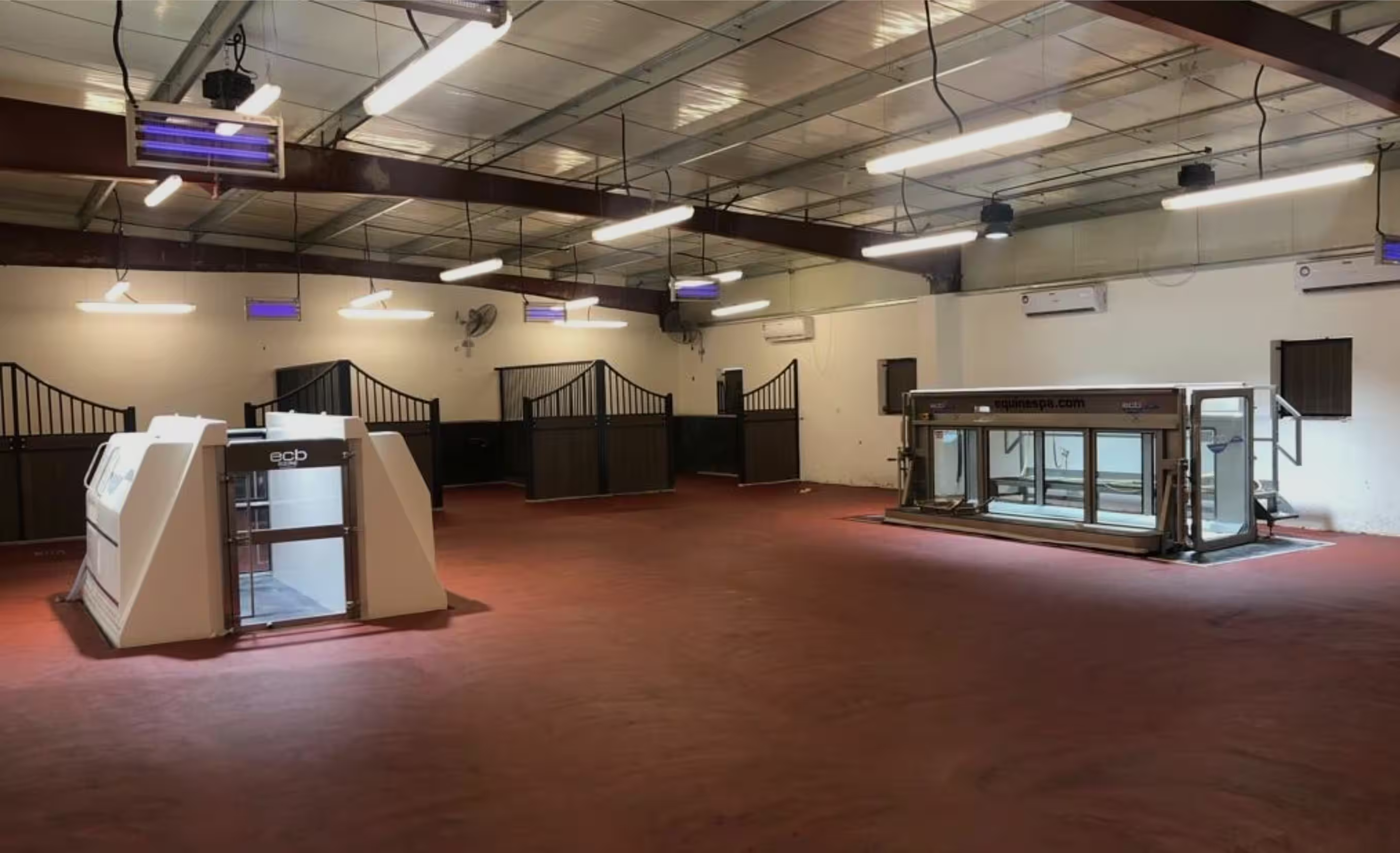
The question that gets asked most often before a hydrotherapy bay is bought, and answered least often after, is: how long does this take to pay for itself? It is a fair question. A water treadmill or saltwater spa is a meaningful capital commitment, and the case for buying one rests on what it can earn — not on what it looks like in a brochure.
This piece is the version of that conversation we wish more buyers had before signing. It is built around what ECB Equine Spas operators have said on the record about their own facilities. Where we have a hard number, we cite it. Where we do not, we say so. The goal is a realistic year-one picture you can put in front of a partner, a lender, or a board.
A hydrotherapy bay is a billable treatment chair, not a stable amenity. The unit operates on two distinct revenue streams that look almost identical from the equipment side but very different from the demand side.
Rehabilitation work — recovery from soft-tissue injury, post-surgery, lameness, foot issues — is referred and scheduled. The clients are veterinarians and owners working through a defined treatment plan. Margins are higher because the alternative for the client is a longer recovery and more risk.
Prevention and conditioning work — daily or weekly sessions for performance horses, racing yards, eventing yards, and high-level dressage and cutting strings — is repeat business. Margins are lower per session, but volume is steady, predictable, and counter-cyclical to the injury caseload.
The strongest rehab centers run both, and the equipment supports both without modification. Bruce Jackson at Fair Hill said it plainly: "The ECB Spa is the most popular piece of equipment in our therapy center. During our peak season, we treat over twenty horses daily for both prevention and rehabilitation. We bought the spa in 2009 and it still looks like the day it arrived."
That sentence — twenty horses daily, prevention and rehabilitation, both — is the operating model.
The first variable in any ROI model is throughput. How many sessions can a single hydrotherapy bay realistically deliver per day?
Numbers from named ECB operators, on the record:
A reasonable planning band is 12 to 20 sessions per day, six days a week, for a busy commercial site. New facilities tend to start at the bottom of that band and build into the top of it over the first 9 to 15 months as referrals compound.
A 20-minute session, including walking in and out and a brief rinse-down, means a single bay can handle four sessions per hour at sustained pace. Twelve sessions a day fills three hours of operating time. Twenty sessions a day fills five. The unit is not the bottleneck — staffing, intake scheduling, and stalls are.
ECB's own unit specification tracks with this. The 2,000-litre water charge in an Equine Spa supports up to 3,000 treatments before a full water change. That is months of operating capacity per change at any realistic day rate.
Two markets, two patterns.
United States. Pricing is fragmented across rehab centers, training yards, racetracks, and mobile operators. We have one cleanly published example to anchor: Champion Fit Equine publishes $45 per session for haul-in clients and $35 per session for boarders for an ECB Spa session. Rehab centers in the Northeast and Florida thoroughbred regions sit higher than that on a per-session basis; cutting and barrel circuits in the South and Southwest sit lower. We are not going to publish a synthetic national average — get three quotes in your region before you build your model.
United Kingdom. Pricing is more public and more consistent:
A typical UK rehab session lives in the £40 to £55 band; a US rehab session lives in the $40 to $90 band; mobile operators fall below those numbers because they trade margin for higher utilisation.
For a planning model, an honest starting assumption is: 15 sessions per day, six days a week, at $45 per session blended (US) or £45 per session blended (UK). That is $675 per day, six days a week, ~$210,000 per year of treatment revenue from a single bay — before you add the higher-margin rehab caseload from veterinary referrals, which is where the real upside lives.
Fair Hill Equine Therapy Center, Elkton, Maryland, is the most cited commercial reference point in equine hydrotherapy because the operating model is unusually clean. The facility is run by Bruce Jackson, a former trainer, with his wife Amy, a former jockey. The roster of trainers using it — Graham Motion is on the record about Fair Hill as "an invaluable asset" — reads like a who's-who of mid-Atlantic flat racing.
What the Fair Hill testimonial tells you about year one:
A specific year-one payback number from Fair Hill is not in the public record, and we will not invent one. The qualitative signal — most popular, peak twenty horses daily, still looks new — is more useful than a fabricated number anyway.
This is the part of the conversation most marketing copy avoids because it is hard to manufacture. We did not have to. ECB's review archive contains an unusual concentration of operator-grade revenue statements, on the record, with names attached.
"Largely due to veterinary referrals within the first year of operation, the ECB Equine Spa has undoubtedly been the most profitable, most widely used piece of equipment in the facility." — Brenda Mcduffee, The Sanctuary, Ocala, FL
"The revenue from the spa actually funded the expansion of our facility and our business is thriving like never before!" — Travis Hunter, Equine Rehabilitation and Conditioning, San Juan Capistrano, CA
"It has generated a new source of revenue for our business and the operation and maintenance has been very easy and low cost." — Daniel Vernay, Selway Equine Therapy Center, Whitesboro, TX
"I purchased the very first ECB Equine Spa […] built back in 2001. The results I have on a daily basis and the running and appearance of the machine hasn't changed a bit." — Emma Hawthorne, Flawborough Equine Centre, Nottingham
"We put an ECB spa in last summer to deal with leg injuries such as tendons and high suspensory's. We had such success we decided to get a second spa." — Louise Cornwell, Longholes, Newmarket
That last quote — bought one, did well enough to buy a second inside a year — is the pattern we see most often at the high end of the throughput band. Repeat purchase is the strongest signal a payback model can give you.
ROI conversations often start at the revenue side. They should also include the cost side, because the hydrotherapy bay reduces a real, expensive line item: lost training days from soft-tissue and lower-limb issues.
US thoroughbred racing's fatal-injury rate is at a record low — 1.07 per 1,000 starts in 2025, down 47 percent from 2.0 in 2009. That is the headline number. The less-headline number is the much larger volume of non-fatal soft-tissue and tendon issues that take horses out of work for weeks or months at a time. Brendan Powell's testimonial on the ECB review archive — "I was gutted when Cruise the Fairway broke down badly in the Hennassy Gold Cup and I thought it would finish his career, but now three and a half months later his legs feel better than before the Hennassy" — is one of the cleaner examples on record.
For a performance stable that owns its horses, the offset to capex is straight-line: fewer lost training days, fewer extended vet bills, faster return to competition. AAEP's published fee survey puts an extended lameness exam at an average $158.14 and a colic exam at an average $186.26 — those are the small line items. The big line items are the trainer fees, the entry fees, and the prize money that disappear with every month a horse is out.
For a commercial rehab center, the offset is on the demand side. The same trend that drove the fatal-injury rate down — better diagnostics, better referral pathways, more aggressive use of rehab — is also the trend that fills the bay.
The honest version of a year-one model:
Year-one payback is realistic on a 15+ session day at honest market pricing. The exact crossover month is configuration-, geography-, and referral-network dependent — we are not going to publish a single number across all geographies because it would mislead more than it would help. Ask ECB for a worked example for your operating profile.
We will not pretend that every ECB bay reaches twenty horses a day. Fair Hill does. The Sanctuary does. S Bar S does. Many bays settle at twelve, and that is still good economics. Geography matters. Referral relationships matter more. A site that opens cold with no veterinary network nearby will take longer to fill than a site that opens inside a thoroughbred corridor or a high-density eventing region.
We will also not pretend that the ROI is identical across the product range. Aqua treadmills and saltwater spas have the strongest year-one revenue case because they serve both prevention and rehabilitation; INSTANTCRYO and high-speed treadmills have longer ramp curves because the customer education is still under way in most regions.
There is no single number across geographies and configurations, but the operating pattern at named ECB sites is consistent. Throughput builds across the first 9 to 15 months as veterinary referral pathways open. Brenda Mcduffee at The Sanctuary described the ECB Equine Spa as the most profitable piece of equipment in her facility "largely due to veterinary referrals within the first year of operation." Travis Hunter at Equine Rehabilitation and Conditioning in San Juan Capistrano described the spa's revenue as having funded the facility's expansion. The most reliable signal that a bay is paying back ahead of schedule is when the operator buys a second one — which is what Louise Cornwell at Longholes did inside a year.
A 20-minute treatment cycle, including walk-in and rinse-down, means a single bay can handle three to four sessions per hour at sustained pace. The named operating ceiling is around twenty horses a day at peak (Fair Hill, S Bar S, Charlie Longsdon). The realistic planning band for a busy commercial site is 12 to 20 sessions per day.
Per-session operating cost (salts, electricity, water, depreciation, allocated staff time) settles in the low double-digit dollars or pounds on a high-volume bay. Session pricing sits in the $40 to $90 band in the US and £40 to £55 band in the UK. The contribution margin per session is the source of the year-one payback math.
Both, run together. The prevention work fills the calendar with predictable repeat business. The rehab work generates the higher-margin sessions and the veterinary referral relationships that compound. Fair Hill, The Sanctuary, and Selway all run both at scale.
Yes — to a degree that is unusual in this category. Bruce Jackson's 2009 ECB Spa "still looks like the day it arrived." Jim Helzer's seven-year reference; Emma Hawthorne's 2001 unit, still running. Durability is part of the ROI model and should be treated as such on the depreciation line.
If you are modelling a hydrotherapy build or expansion, the next useful conversation is a configured quote with throughput assumptions for your market. Contact ECB Equine through the Contact Us page, and review the Aqua Treadmill product page, the Equine Spa product page, and the Rehabilitation Centers solution page for the full equipment and facility context.