

"Equine hydrotherapy" is not one thing. It is a category containing at least four modalities that do genuinely different physiological work, and the most common expensive mistake in this sector is a facility buying the wrong one — not because it bought badly, but because it bought before it had worked out which job it was hiring the equipment to do.
This guide sets out what each modality does, which injuries and objectives each suits, how sessions are structured across a rehabilitation cycle, and how a facility builds a hydrotherapy programme that pays for itself. It is written for the people specifying and running these systems — rehabilitation centre owners, veterinary clinicians, and racing and training yard managers — rather than for the individual horse owner. It also says plainly what hydrotherapy does not fix, because the limits matter as much as the indications.
Cold hosing aside — which is hydrotherapy in the loosest sense and is mostly a way of spending twenty minutes achieving very little — commercial equine hydrotherapy comes down to four systems.
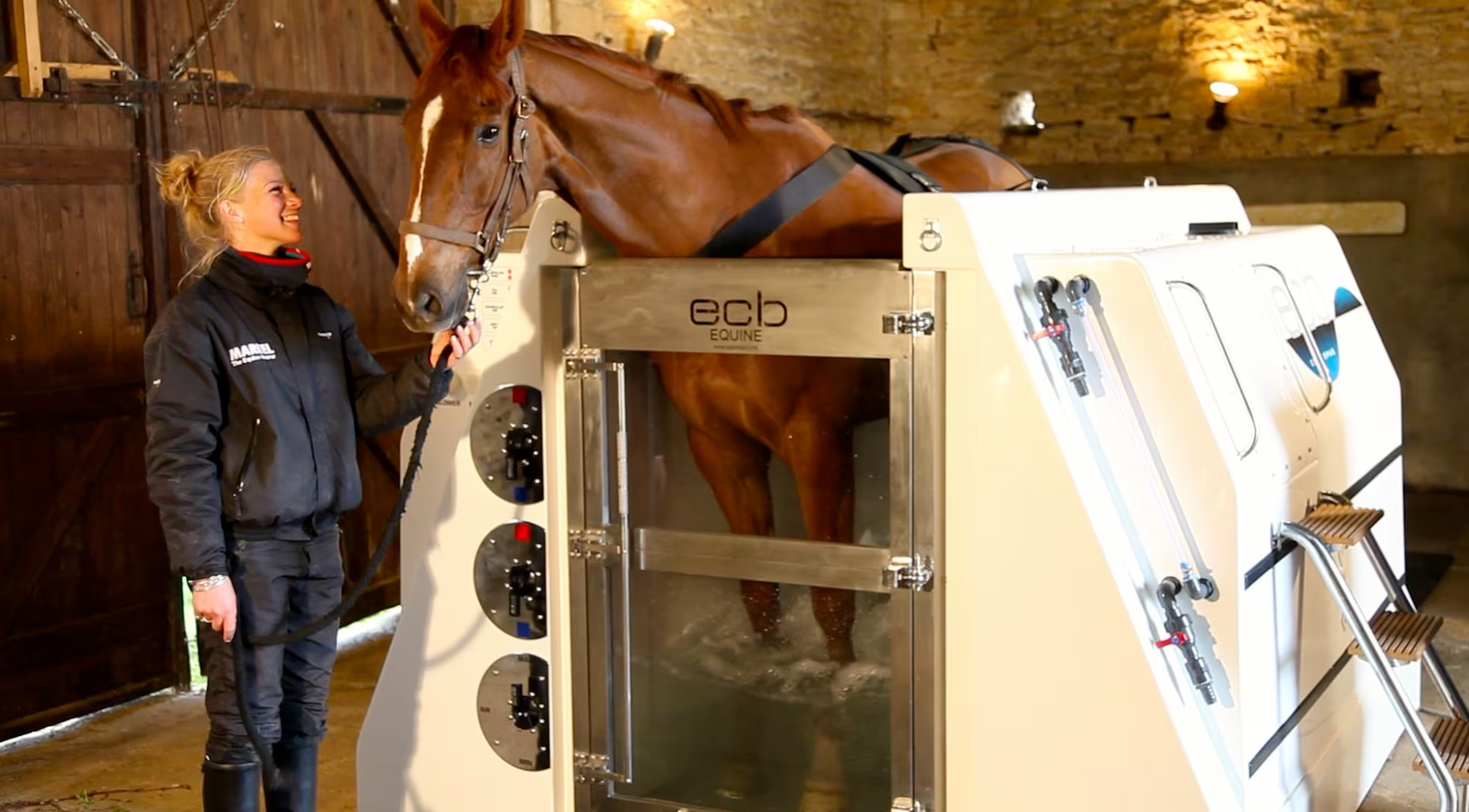
The horse stands in a closed tank of high-salinity water chilled to approximately 2°C (35°F), typically for 10 to 20 minutes, with all four lower limbs immersed. Salt concentration runs to roughly ten times that of seawater. Three mechanisms act at once: profound cold, hydrostatic pressure from the water column, and the osmotic effect of the salt drawing fluid out of inflamed tissue. It is a recovery and acute-inflammation tool, not an exercise tool — the horse does no work. Its defining commercial characteristic is throughput: a short session, one operator, no exercise physiology to plan, four limbs treated simultaneously. See the ECB Equine Spa and its full feature specification.
The horse walks on a submerged belt in a tank whose water depth, speed and incline you control. This is the only modality that applies graded, repeatable, documented load to healing tissue. Depth is the primary variable: shallow water gives near-normal loading with mild resistance; deeper water increases joint flexion and range of motion while unloading the limb; deeper still and the horse begins to float, at which point control is lost. Incline recruits the hindquarters and topline. It is an exercise and rehabilitation instrument. See the ECB Equine Aqua Treadmill and its specifications.
Strictly this is cold therapy rather than hydrotherapy, but it belongs in any honest comparison because it competes for the same budget and treats overlapping cases. Food-grade CO₂ leaves a precision applicator at approximately -78°C and brings the skin surface of a single defined site to about 4°C within 30 seconds, in a treatment of 30 to 90 seconds. The thermal shock produces strong analgesia and a vasodilation rebound when the applicator is removed — that rebound is the therapeutic phase. It is point-source, high-intensity and very short. It treats one structure, in the stable, without taking the horse out of work. See ECB INSTANTCRYO.
Not hydrotherapy at all, but it completes the picture of a modern conditioning facility and is frequently specified alongside the others. A high-speed treadmill delivers controlled fast work — speeds to 45 km/h with incline — on a cushioned bed, without a rider and without the surface variability of a gallop. It is a conditioning and testing instrument, not a rehabilitation one. See the GG Engineering high-speed treadmill, manufactured by GG Engineering and supplied by ECB.
Most confusion about hydrotherapy comes from treating "water therapy" as a single effect. It is three effects that can be combined or isolated, and knowing which one you are prescribing changes what equipment you need.
Cold causes cutaneous vasoconstriction, reduces blood flow to an acutely inflamed site, dampens the inflammatory cascade and produces measurable analgesia. It is the right tool in the first phase after injury and after hard work. It does nothing to remodel tissue and nothing to build strength. Cold is available from a spa (whole lower limb, sustained, moderate intensity) or from cryotherapy (one site, seconds, extreme intensity). Those are different prescriptions, not two brands of the same thing.
Salt is osmotic. A hyper-saline environment draws fluid out of damaged tissue and through the skin's natural barriers, which is why cold saltwater is markedly more effective than cold fresh water for reducing distal limb filling. Salt is also mildly antiseptic, which is why a spa is so effective on surface conditions — early-stage wounds, mud fever, cracked heels — that have nothing to do with the reason most facilities buy one. Salt is available only from a spa, or from a water treadmill run in salt configuration.
Buoyancy and resistance are the exercise mechanisms. Buoyancy removes load; resistance adds work; hydrostatic pressure assists venous and lymphatic return throughout. Together they allow a horse to exercise at an intensity its damaged tissue could not tolerate on dry ground. Only a water treadmill lets you dose them, because only a water treadmill combines them with a gait you control.
A facility that understands these three separately stops asking "which machine is best" and starts asking "which mechanism does this caseload need, and how often". That question has a much clearer answer. Our detailed comparison of cold saltwater hydrotherapy versus cryotherapy works through the two cold modalities in depth.
What follows is how these modalities are typically sequenced. Every protocol must be written with the treating veterinarian against the specific horse, the specific diagnosis and the imaging — none of this substitutes for that.
Superficial digital flexor tendon injury. The classic sequence, and the one that best illustrates the logic. Acute phase: cold and compression, no exercise — spa sessions to control the inflammatory response, with localised cryotherapy on the lesion where a targeted dose is wanted. Sub-acute and early remodelling: controlled loading begins, and this is where the water treadmill becomes central. Short, shallow, frequent sessions applying enough load to orient collagen without exceeding what the repair tissue tolerates. Progression is by one variable at a time — usually duration first, then depth, then speed — guided by re-scan intervals. Late phase: increasing load toward a return-to-work volume, with spa sessions continuing after work as recovery. The critical point is that swimming cannot substitute for the treadmill phase; unloaded exercise does not organise collagen.
Suspensory ligament desmitis. Similar architecture, generally slower, with proximal lesions in particular demanding patience. Cold early. Controlled loading introduced conservatively; the tolerance window is narrower than for SDFT and over-progression is the common failure. Straightness matters here, and a treadmill belt enforces it in a way that hand-walking does not.
Post-surgical rehabilitation. Determined by the surgeon's loading instruction, which overrides everything else. Where weight-bearing is permitted, a water treadmill provides the most controllable route back to load. Where weight-bearing is genuinely contraindicated, the horse needs unloaded exercise, and a swimming pool is the only modality that provides it — one of the few clear indications for a pool. Once loading is permitted, the treadmill takes over.
Laminitis support. Cold therapy has a well-established role in the developmental and acute phases, and distal limb cooling is standard supportive care. Exercise-based hydrotherapy is not appropriate in acute laminitis and the timing of any return to controlled movement is entirely a veterinary decision. A spa's role here is cold, not conditioning.
Osteoarthritis and joint mobility. Water treadmill at a depth that maximises flexion while minimising concussion. This is one of the strongest applications of the modality, because deeper water demands more range of motion while asking for less weight-bearing — a combination difficult to reproduce any other way. Regular, moderate, long-term rather than intensive short blocks.
Loss of topline and epaxial muscle. Water treadmill with incline, progressive, over months rather than weeks. Research on water treadmill work has shown measurable increases in epaxial muscle profile in horses on consistent inclined-resistance programmes — see our summary of that research.
Back pain and sacroiliac dysfunction. Water treadmill at a depth that encourages the horse to lift through the back and engage the abdominal sling. Swimming deserves particular caution in these cases: swimming horses typically extend the neck and hollow the thoracolumbar spine, which is the opposite of what most back cases need.
Routine post-exercise recovery. Spa, daily, 10 to 20 minutes after work. This is not rehabilitation at all — it is the highest-volume, lowest-complexity use of hydrotherapy, and in a busy yard it is the application that generates the most sessions per week.
The single most common programme error is escalating several variables at once. A horse comes back well from a session, and the next day the operator adds duration, depth and incline together. When the horse then presents sore, nobody knows which change caused it, and the programme loses a fortnight re-establishing a baseline.
The disciplines that make hydrotherapy programmes work are unglamorous:
Change one variable at a time. Duration, then depth, then speed, then incline. Hold everything else constant across the increment.
Favour frequency over duration in early rehabilitation. Remodelling tissue responds to regular modest stimulus better than to occasional large ones. Short daily sessions beat long thrice-weekly ones in the early phases.
Record every session. Depth, speed, incline, duration, water temperature, and the horse's response. This is what allows you to know what worked, to defend a decision to a referring vet, and to show an owner what their money bought. Programmable protocols help here — the ECB Aqua Treadmill's stored programmes mean a prescription is executed identically whoever is on shift, rather than reinterpreted each morning.
Re-assess at imaging intervals, not at feeling intervals. Progression should be gated by the vet's re-scan, not by how the horse looked on Tuesday.
Plan the deceleration. Programmes usually plan the build and improvise the return to normal work. The transition back to ridden work is where re-injury clusters.
Our 12-week water treadmill programme sets out a full progression week by week, and the veterinary clinic protocols guide covers documentation and clinical governance in more depth.
Hydrotherapy equipment does not generate a return because of what it can do. It generates a return because of how often it is used. Three numbers determine the outcome, and only one of them is on the specification sheet.
Utilisation. Sessions per week, actually delivered. This is the dominant term and it is where most business cases quietly fail. A machine that suits nine in ten of your intake and runs six days a week outperforms a more capable machine that suits half your intake and runs three. It is also why session length matters commercially: a 15-minute spa session and a 45-minute treadmill session have very different throughput ceilings on the same working day.
Staffing per session. A modality needing two or three handlers has a fundamentally different cost base from one needing a single trained operator. Multiply that difference by every session for five years before deciding it is a detail.
Downtime. Unplanned downtime costs revenue twice — the sessions not delivered, and the referrals that go elsewhere and frequently do not come back. Service regime and parts availability are commercial decisions, not maintenance ones.
The practical implication is that most facilities should specify around their routine caseload rather than their most interesting cases. The complex referral that arrives twice a year is not what pays for the building. Our first-year hydrotherapy ROI analysis works through this arithmetic properly, and the rehabilitation centre equipment checklist covers what else has to be in the build.
A manufacturer's most useful contribution is usually the honest limits, so:
It does not replace diagnosis. Hydrotherapy applied to an undiagnosed lameness is guesswork with expensive equipment. Image first.
It does not fix structural pathology. A displaced fracture, a chip that needs removing, an unstable joint — these are surgical problems. Hydrotherapy supports the recovery; it does not substitute for the intervention.
It does not accelerate tissue biology beyond its natural rate. Tendon remodelling takes the months it takes. Well-designed hydrotherapy improves the quality of the repair and reduces re-injury risk; it does not compress the timeline, and any programme sold on the promise that it will should be treated with suspicion.
It does not compensate for the underlying cause. If a horse is breaking down because of shoeing, surface, workload or conformation, hydrotherapy manages the consequence while the cause continues. The rehabilitation will succeed and the horse will return and break down again.
It does not work without operator competence. The equipment is the smaller half. A well-run programme on modest equipment beats a poorly-run one on the best machine available, every time.
Veterinary clinics and equine hospitals. Water treadmill as the primary system — your caseload is diagnosed pathology needing prescribed, progressive, documentable load, and you need the record. Cryotherapy as a high-value adjunct for targeted acute work and in-clinic treatment. A spa where case volume justifies it. See equine systems for veterinary clinics.
Rehabilitation centres. Water treadmill plus cold saltwater spa is the core pairing, and it covers the large majority of a rehabilitation caseload — the treadmill for controlled loading, the spa for the acute phase and for post-session recovery. Cryotherapy adds targeted capability at comparatively low capital cost. See equine systems for rehabilitation centres.
Racing yards and training facilities. The daily problem is recovery across a large string, so the spa is usually the first purchase and the one with the highest utilisation. A water treadmill earns its place for horses returning from injury and for out-of-season topline work. A high-speed treadmill for controlled fast work and fitness testing. Cryotherapy is valuable in-season because it treats without interrupting the training schedule. See equine systems for racing yards and training facilities.
Performance stables and equestrian centres. Spa for daily maintenance across the string; water treadmill for conditioning, straightness and topline. Cryotherapy for the competition season, where the ability to treat a specific structure without taking a horse out of work is worth a great deal. See equine systems for performance stables.
Mobile and event operations. Where the requirement is at racetracks, shows or events rather than at a fixed site, a mobile equine spa delivers the same cold saltwater therapy on a transportable platform.
Equine hydrotherapy is the therapeutic use of water to treat, rehabilitate and condition horses. In commercial practice it means three distinct things: cold saltwater spas, in which the horse stands in chilled high-salinity water to control inflammation and reduce swelling; water treadmills, on which the horse walks against controlled water depth, speed and incline to apply graded load to healing tissue; and swimming pools, which remove load almost entirely. Localised cryotherapy is usually discussed alongside them because it treats overlapping cases, though it uses CO₂ rather than water. They work by different mechanisms and are not interchangeable.
The benefits depend on which mechanism is being applied. Cold reduces acute inflammation, limits swelling and provides analgesia. Salt is osmotic, drawing fluid out of damaged tissue, and is mildly antiseptic — which is why cold saltwater outperforms cold fresh water for distal limb filling and helps with surface conditions such as early-stage wounds and mud fever. Buoyancy and resistance together allow exercise at an intensity damaged tissue could not tolerate on dry ground, which supports controlled tendon and ligament loading, joint range of motion, topline and epaxial muscle development, and low-concussion cardiovascular conditioning. Hydrostatic pressure assists venous and lymphatic return throughout.
Frequency is set by the case and by the modality. Cold saltwater spa work used for post-exercise recovery is typically applied daily, sometimes twice daily, in sessions of 10 to 20 minutes. Water treadmill work in early rehabilitation favours short, frequent sessions on most days, because remodelling tissue responds better to regular modest stimulus than to occasional large ones; conditioning work in a fit horse is usually a few times weekly within a wider programme. Whatever the frequency, progress one variable at a time — duration, then depth, then speed, then incline — and gate progression on the veterinarian's re-imaging rather than on how the horse looked yesterday.
Both, in sequence. In the acute phase, cold and compression: cold saltwater spa sessions to control the inflammatory response, with localised cryotherapy where a targeted dose to the lesion is wanted. Once the veterinarian permits controlled loading, the water treadmill becomes the central tool, because tendon collagen aligns along the lines of force applied to it and organised repair requires progressive load. This is the reason swimming is a poor choice for tendon rehabilitation — it removes load almost completely, so the tissue is given no stimulus to organise, and disorganised scar tissue is what re-injures.
It depends on which modalities you specify and, just as much, on your site — and the site is where budgets are usually broken. Beyond the equipment itself, plan for electrical supply (chilling plant and drives are substantial loads, often three-phase), water supply with adequate fill rate, legal drainage (saltwater discharge is regulated in many jurisdictions), floor loading capable of carrying a full tank plus plant plus a horse, and physical access for delivery and installation. The number that actually determines whether the investment works is not the capital cost but the cost per session, which is capital plus running cost divided by realistic utilisation. ECB provides a site survey and a specification against your caseload before quoting; contact us to arrange one.
If you are planning a build, an expansion or a first hydrotherapy purchase, the productive conversation is not about products. It is about your caseload, your building, your staffing and your realistic utilisation — and it frequently ends somewhere different from where the enquiry started. ECB has worked through that specification process with over 500 facilities worldwide.
Browse the full product range, or go direct to the cold saltwater equine spa, the water treadmill, INSTANTCRYO localised cryotherapy, or the high-speed treadmill. The spa locator shows facilities running ECB systems worldwide, and many will let a prospective buyer see a machine in daily use.
To arrange a specification conversation or a site survey, use our contact page — or call +1 973-383-5511 (Americas) or +44 (0)1451 822969 (UK and rest of world).