

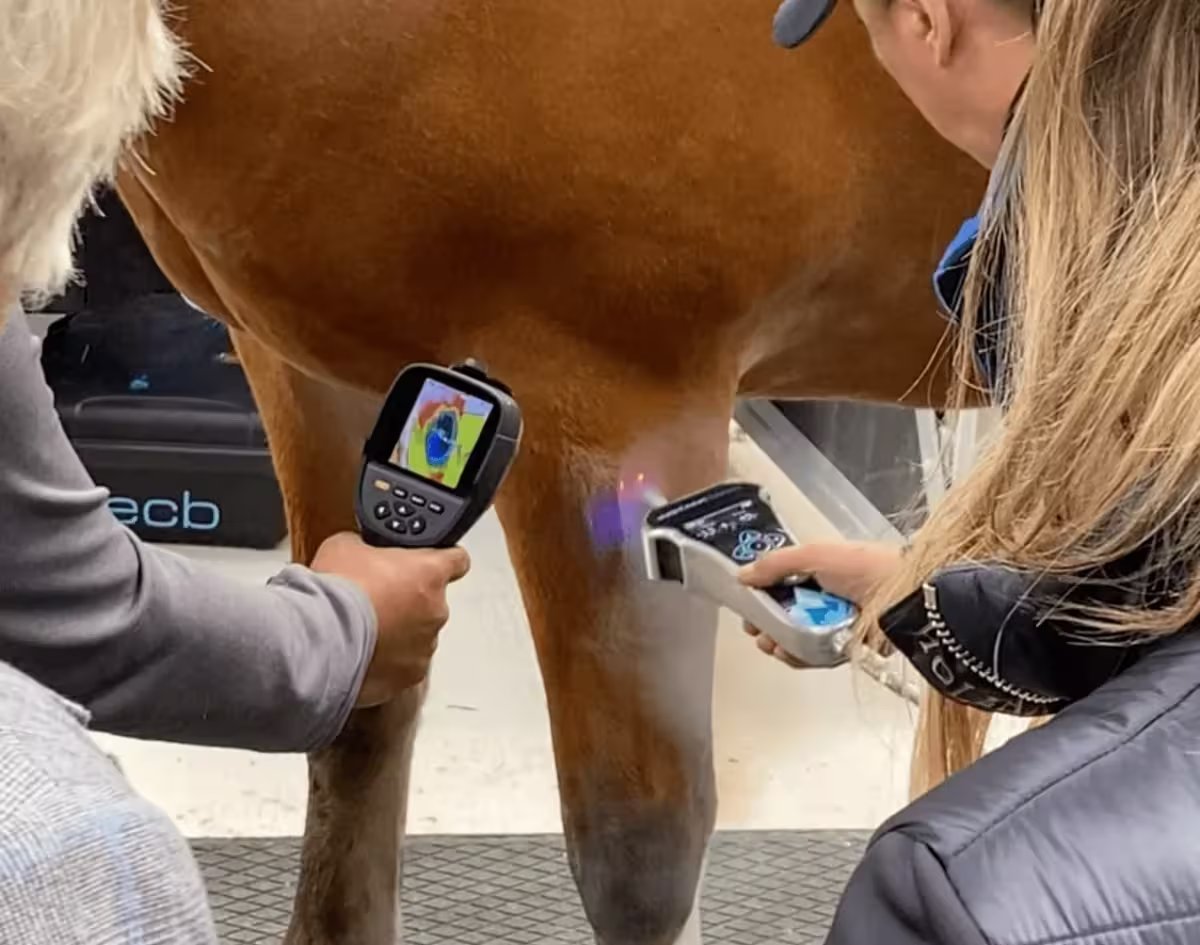
Five days. That is the window the FEI gives you. Under Article 1065.3 of the FEI Veterinary Regulations 2026, cryotherapy is prohibited at FEI Events and in the 5 days before them. For a showjumper, eventer or dressage horse on a busy calendar, that single rule shapes how cold therapy fits into the week far more than any brochure claim does.
This guide is for riders, yard managers and vets who already know what cryotherapy is and want to use it well around competition. It covers where cold fits in a competition horse's week, how to plan around the FEI rules, how localised CO2 cryotherapy compares with a cold salt water spa and ice for this job, and how top yards build it into a routine without putting a start at risk. If you want the basics first, read our guide to cryotherapy for horses.
A leisure horse with a sore tendon can follow a textbook cold therapy plan. A competition horse can't. Its year is built around fixed dates, travel, and rules that decide what you may and may not do in the days before a class.
Three things make competition horses different:
That is why the yards that get the most from cryotherapy treat it as part of a plan, set with their vet, rather than something reached for when a problem appears.
Before planning anything, know the rules. The current FEI Veterinary Regulations 2026 (15th edition, effective 1 January 2026) set out three points that matter here:
In plain terms, localised cryotherapy has to finish at least five full days before an FEI event. At the event, you are limited to ice and water cooling at or above 0°C, and to cooling machines that officials can lock above 0°C.
National rules vary. British Showjumping, British Eventing and British Dressage each publish their own regulations, and they change. Check the current rules for every competition, and agree your plan with your vet, before you start a cryotherapy programme for a horse that competes.
Localised cryotherapy uses a handheld device to deliver food grade liquid CO2 at -78°C (-108°F) under high pressure to a small, precise area. With the ECB INSTANTCRYO, the treated skin surface drops to approximately 4°C (39°F) within 30 seconds, and a treatment typically takes 30 to 90 seconds per site.
That speed changes how cold therapy fits a competition yard. There's no tank to fill, no ice to source and no 20 minutes of hosing. One person can treat a horse in the time it takes to tack up.
The rapid drop in skin temperature causes the blood vessels in the area to narrow. When treatment stops, circulation to the area increases. That rebound, called reactive hyperaemia, is why many trainers use localised cold on tight muscles as well as on legs.
The second effect is comfort. Cold slows nerve conduction, so the treated area is less sore for a period afterwards. For a horse with a tight back or a stiff shoulder after a long day, that can make the next session of work easier.
Ice boots and spas cool the lower limb. A handheld device can be pointed at the back, the hindquarters, the shoulder or the neck. For showjumpers and eventers, whose work loads the back and hind end heavily, that reach is often the main reason a yard adds localised cryotherapy to the cold therapy it already has.
The five-day rule means the most useful window for localised cryotherapy is straight after a competition, not before it. Here is how many sport horse yards structure the cycle. Treat it as a starting framework to adapt with your vet, not a prescription.
At an FEI event, localised cryotherapy is off the table. Cooling is limited to ice and water at or above 0°C, and to approved, locked machines. Cold hosing, ice boots used within the rules and walking off are the tools here. Note anything you see: heat in a leg, a reluctance to stretch, a short stride behind. These notes drive the next few days.
Once the horse is home, this is where localised cryotherapy earns its place. Your vet may suggest treating specific sites the day after travelling home, for example the back muscles of a showjumper after a big track, or the lower limbs of an eventer after cross country.
A thermal imaging camera helps here. Scan the horse before treatment to find warm areas, treat those sites, then scan again to confirm the temperature drop. The INSTANTCRYO package includes an HD thermal imaging camera (320x240) for exactly this reason. Recording each scan gives you and your vet a picture of how the horse is recovering from one show to the next.
Count back five days from the next FEI event. That date is your last day for cryotherapy. If the next show is a national one, check its rules, which may differ. Build the rest of the week around your normal training plan, with cooling methods that are allowed closer to the event.
On a tight calendar, for example an FEI show one weekend and another the next, the gap may only leave a day or two of permitted treatment. Plan this before the season starts. Some riders choose which shows to use cryotherapy around and which to skip it for. Others rely on a cold salt water spa between close starts, used within whatever cooling rules apply.
Most top yards don't pick one cooling method. They use different tools for different jobs. Our comparison of cold saltwater hydrotherapy and cryotherapy goes into the detail, but here's how they line up for competition horses.
The ECB Equine Spa holds around 2,000 litres of high salinity water and supports up to 3,000 treatments before a full water change, which is why it suits yards with several horses in hard work.
A practical set-up many competition yards use: the spa for daily lower limb cooling, localised cryotherapy for specific sites in the recovery window after a show, and ice and hosing at the event itself.
ECB Equine has supplied equine hydrotherapy equipment since the 1990s, with more than 500 installations in over 20 countries. Many of those are competition yards.
Olympic showjumper Cian O'Connor has used ECB spas for more than 10 years and had his first ECB water treadmill six years ago. This December he's installing a new ECB spa, aqua treadmill and INSTANTCRYO in Ireland. Swedish showjumper Henrik von Eckermann, based in the Netherlands, had an ECB water treadmill installed this year. Wathnan Equestrian Centre in Qatar, which covers every equestrian discipline, was built this year with an ECB spa and water treadmill. ECB treadmills are also used by the Royal Families of Bahrain and Dubai.
The common thread is that cold therapy sits alongside other tools. A spa handles the daily routine, a water treadmill builds fitness with less concussion, and localised cryotherapy covers the targeted work. If you're planning a yard on similar lines, our guide to hydrotherapy for performance stables shows how the pieces fit together.
Localised cryotherapy is a recovery tool. It supports the plan your vet sets. It doesn't replace diagnosis or treatment, and it shouldn't be used to keep a horse in work through a problem that needs proper attention.
Good practice for competition yards:
Most horses accept localised treatment without restraint once they're used to the sound.
If you're weighing up a handheld unit for a competition yard, here's what comes with the ECB INSTANTCRYO equine cryotherapy machine:
The main running cost is CO2. Our equine cryotherapy machine cost guide shows how to estimate gas use from your weekly treatment count and local cylinder prices. ECB doesn't publish list prices, because the final figure depends on the package and where the unit is going.
If you'd like to talk through how INSTANTCRYO would fit your competition calendar, contact the ECB Equine team. The US office covers North and South America, and the UK office in Bourton-on-the-Water covers the rest of the world.
Under Article 1065.3 of the FEI Veterinary Regulations 2026, cryotherapy is prohibited at FEI Events and in the 5 days prior to them. Plan for your last treatment to fall at least five full days before the event. National federation rules can differ, so check them for every show.
Yes, within limits. Article 1062.6 allows cooling with ice and water as long as the temperature is not below 0°C. Cooling machines are only allowed if officials can lock them so the temperature can't fall below 0°C, under Article 1062.7.
They do different jobs. A cold salt water spa cools all four lower limbs at once and suits a daily routine. Localised cryotherapy targets specific sites anywhere on the body, such as the back and hindquarters, which take a lot of load in showjumping. Many competition yards use both.
Typically 30 to 90 seconds per treatment site. With the ECB INSTANTCRYO, the treated skin surface reaches around 4°C within 30 seconds, so a horse with two or three sites to treat can be done in a few minutes.
Your vet should diagnose any injury and agree the treatment plan. You don't need to be a vet to operate INSTANTCRYO, but every purchase includes one to one training with a certificate, so the person using it knows how to apply the protocols safely.
Yes. Because localised CO2 cryotherapy is delivered from a handheld device, it can reach the back, shoulder, neck and hindquarters, areas that ice boots and spas can't cool. Your vet should decide whether those sites are appropriate for your horse.